Foodzilla vs NutriAdmin: Which Fits Your Dietitian Practice?
Tuesday morning. Ten meal plans due before noon, three intake forms still waiting, two invoices to chase. You're picking the tool that handles it, and two names keep surfacing: Foodzilla and NutriAdmin. They play different games. Foodzilla is a meal-planning specialist that builds plans with AI and ships a white-label client app. NutriAdmin bundles CRM, scheduling, telehealth, billing, and a meal-planning module into one all-in-one hub. Here's an honest side-by-side from a private-practice dietitian's lens, with the macro precision gap neither one closes.

Quick Verdict
Pick Foodzilla if meal planning is the core of your service and you want speed. AI-generated plans, a recipe library, a white-label client app on higher tiers, and a ticket that starts near $29/month depending on your client count. The platform sits around 4.2 stars on Capterra (roughly 27 reviews), with broad feature coverage for plan production. The accepted trade-off: review every AI-generated plan before you send it.
Pick NutriAdmin if you want one platform to run the whole practice. CRM, intake forms, scheduling, telehealth, messaging, billing, and meal planning all sit in the same dashboard. The Starter plan opens at $24.99/month, the rating climbs to 4.7 stars on Capterra (around 128 reviews), and the platform serves practitioners across 100+ countries with a multi-language interface. The meal-plan module builds a day in about 60 seconds using an algorithm plus ChatGPT.
Neither one enforces macro precision to the gram. Foodzilla bets on AI, which moves fast but risks approximate nutritional numbers at scale. NutriAdmin combines an algorithm and ChatGPT, but reviews flag plans that repeat meals and need manual adjustments. If macro precision is the core of your premium service, you'll need a dedicated tool alongside either platform. More on that below.
Foodzilla at a Glance
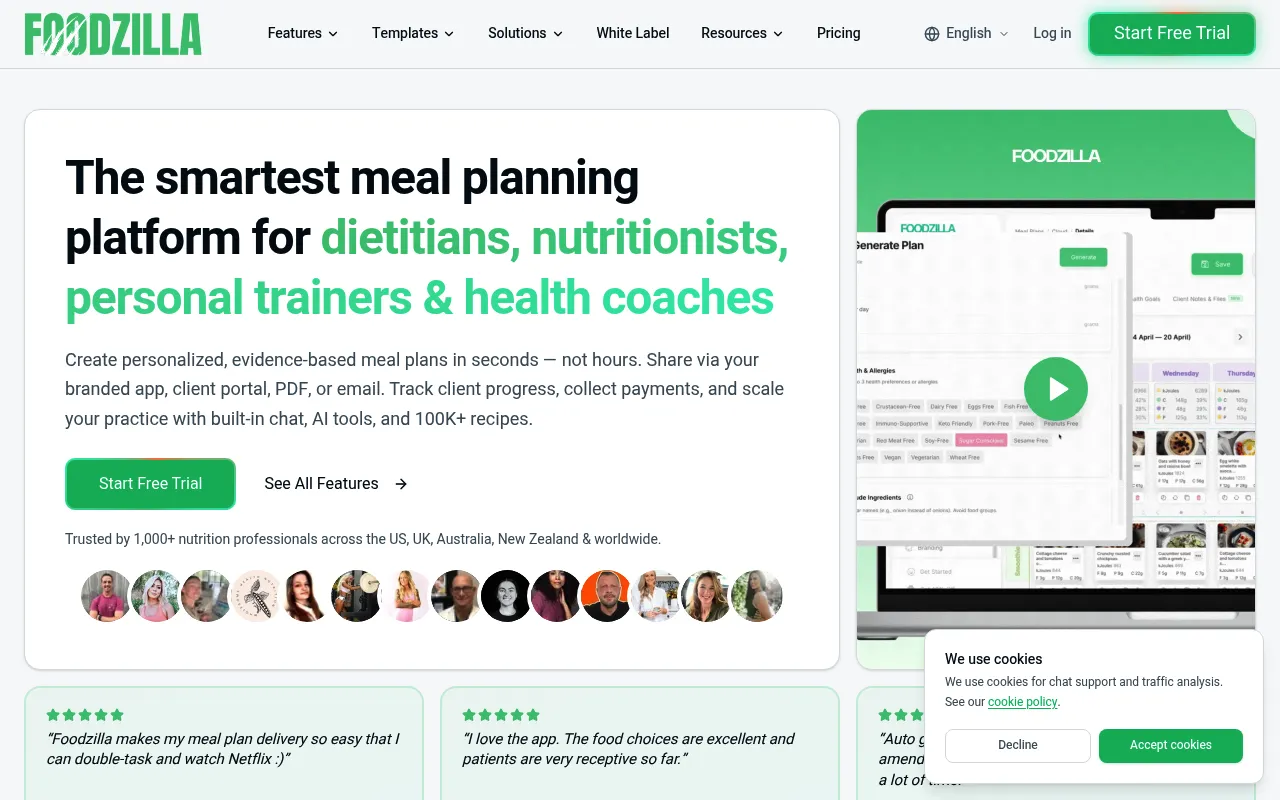
Foodzilla positions itself as a meal-planning-first nutrition platform for dietitians, nutritionists, and coaches who want to automate plan production. The product highlights AI generation that assembles a plan in a handful of clicks, a recipe library, and a white-label client app. The promise: save time on plan creation so you can reinvest it in consultations and client follow-up. Unlike NutriAdmin, Foodzilla doesn't try to run the whole practice. It focuses on the nutrition deliverable.
On pricing, Foodzilla runs a USD grid tiered by client count, near $29 to $59/month. The more clients you carry, the higher the ticket, and the white-label client app opens up on higher tiers. A free trial lets you test the interface and the AI generation before committing. The install base sits more modest than NutriAdmin's, which means a quieter community but also a younger, more agile team on the AI features.
On reviews, Foodzilla pulls a Capterra rating around 4.2 stars (roughly 27 reviews), with positive notes on generation speed and ease of onboarding, and recurring remarks about macro precision and AI suggestions needing a systematic review. For a deep dive, read our complete Foodzilla review.
NutriAdmin at a Glance

NutriAdmin follows the opposite logic: an all-in-one practice hub that bundles CRM, client records, scheduling, online payments, intake questionnaires, reporting, and a meal-planning module. British origin, originally designed for UK and Australian nutritionists and dietitians, now used by practitioners worldwide. The food database draws on USDA (US), McCance and Widdowson (UK), and AUSNUT (Australia) sources to cover over 300,000 food items. The platform holds a 4.7/5 rating on Capterra from around 128 verified reviews.
On pricing, NutriAdmin opens at $24.99/month on the Starter plan, which keeps it affordable for a solo practitioner getting started. Higher tiers (Standard, Professional, Premium) add more clients, advanced scheduling, telehealth, and team features. Annual billing trims roughly 17% off the ticket. The platform serves practitioners across 100+ countries and offers the interface in multiple languages, which makes it natural for English-speaking, Spanish-speaking, and French-speaking practices alike.
On meal plans, NutriAdmin generates plans by combining a proprietary algorithm with ChatGPT. You set the calorie target, macro ratios, dietary preferences, and cuisine type, and the system builds a plan in about 60 seconds. It supports 40+ diets and 18 cuisines. Capterra reviews flag that the plans repeat the same meals often and need manual adjustments. For a deep dive on the practice management side, read our complete NutriAdmin review.
Pricing Side-by-Side (2026)
The pricing models tell you what each platform thinks it's selling. Foodzilla charges by client count, because it sells a volume of plan production. NutriAdmin spreads cost across the whole practice stack, so the entry ticket stays accessible even if you only use a few modules. Here's how they line up.


| Foodzilla | NutriAdmin | |
|---|---|---|
| Free trial | Free trial available | Free trial available |
| Entry plan | From ~$29/mo | Starter: $24.99/mo |
| Higher tier | ~$59/mo (by client blocks) | Standard / Professional / Premium |
| Pricing logic | By client count | By practice tier |
| Plan generation | AI, core feature | Algorithm + ChatGPT, ~60s |
| White-label client app | Higher tiers | Web portal (NutriAdmin-branded) |
| Food database | English-oriented | USDA + McCance + AUSNUT (300,000+) |
| CRM / scheduling / telehealth | Out of scope | Native, bundled |
| Capterra rating | ~4.2/5 (~27 reviews) | 4.7/5 (~128 reviews) |
| Primary market | English-speaking (US, UK, AU) | International, multi-language |
| Key strength | Meal planning + client app | All-in-one practice hub |
For a dietitian getting started, NutriAdmin's $24.99 entry ticket is hard to beat if you want to consolidate CRM, scheduling, and plans into one tool. Foodzilla starts a bit higher and climbs by client blocks, but it spends its whole budget on plan production instead of spreading it across practice management modules. Over time, the right pick depends less on price and more on what you need: a meal-planning specialist that moves fast, or a hub that absorbs the entire practice admin load.
Feature Comparison: AI, Meal Plans, Practice Ops, Integrations
Foodzilla and NutriAdmin cover a dietitian's practice from opposite angles. Foodzilla pushes depth on meal planning and the client app. NutriAdmin pushes breadth on practice management and admin.
On plan generation, both lean on AI but with different intent. Foodzilla makes it the headline feature, built for clients who accept generic plans produced fast. NutriAdmin combines a proprietary algorithm with ChatGPT, but the module stays one brick inside a practice suite, not the core product. Either way, the output needs a review before it goes out.
On practice operations and follow-up, NutriAdmin clearly takes the lead. The platform integrates intake forms that sync with the client record, a calendar tied to Google Calendar, video telehealth, messaging, indicator tracking (weight, measurements, adherence), and Stripe billing. Foodzilla stays focused on plan production and doesn't ship native scheduling or video consultations. For a practice that wants everything under one roof, the gap is significant.
On the client app, Foodzilla takes the edge. The platform offers a white-label mobile app where the client receives plans, recipes, and a grocery list. NutriAdmin doesn't ship a native mobile app: the client uses a web portal that carries NutriAdmin's branding. For a dietitian who wants polished brand presence on mobile from day one, the difference shows.
On integrations, NutriAdmin plays the full-ecosystem card (calendar, Stripe payments, exports, reporting) where Foodzilla bets on productivity-oriented connectors and the English-speaking ecosystem. Depending on your existing stack, the advantage shifts. If you already run your calendar and billing elsewhere, Foodzilla's tighter scope is enough. If not, NutriAdmin's coverage saves you from stacking subscriptions.
Who Foodzilla Is Best For
Foodzilla fits dietitians, nutritionists, and coaches who want to industrialize plan production through AI, and who'll accept a trade-off on fine macro precision in exchange for speed.
Solo dietitian who wants to industrialize plans
Recommended pick. AI generation lets you produce a plan in minutes instead of hours per client. For a solo running 30 to 80 clients who's been spending too much time building plans, the investment pays back fast on time saved. The accepted trade-off: systematically review generated plans for consistency before sending.
Fitness coach adding nutrition to the offer
Strong pick. For a fitness coach who doesn't position as a dietitian but wants to offer supporting meal plans (gentle weight loss, lean bulk, balanced eating), Foodzilla delivers the automation without demanding deep nutrition expertise. Stay within your professional scope per your local regulations.
Practice that wants a white-label client app
Strong pick. Foodzilla offers a white-label mobile app where the client receives plans and a grocery list, where NutriAdmin limits you to a web portal that carries the NutriAdmin brand. For a practice whose image depends on a polished mobile experience, Foodzilla holds a clear edge on client-facing brand presence.
Who NutriAdmin Is Best For
NutriAdmin fits dietitians who want a single platform to run the whole practice, with a massive food database and a bundled meal-planning module.
Solo dietitian consolidating into one tool
Recommended pick. If you're tired of juggling Calendly, Zoom, Square for billing, and a separate meal planner, NutriAdmin bundles the essentials in one interface from $24.99/month. The consolidation simplifies your day and cuts total tool spend. The dashboard ties intake, plan, follow-up, and billing together without re-entry.
Dietitian whose load comes from admin
Strong pick. If your main mental load comes from admin (chasing payments, building forms, client follow-up, reporting), NutriAdmin bundles those functions in one interface. Capterra reviews specifically praise the customer support and how tightly the intake-to-plan-to-report workflow holds together end to end.
International or multi-language practice
Strong pick. The multi-language interface and the 100+ country footprint make it natural for practices serving English, Spanish, or French-speaking clients. The combined USDA, McCance and Widdowson, and AUSNUT database covers over 300,000 food items, useful for expat or frequent-traveler clients.
The Shared Limit: No Macro-Precise Plans to the Gram
Foodzilla and NutriAdmin solve different problems but share the same limit on precise plan production. Neither one enforces per-client protein, carb, and fat targets to the gram across every meal, with fine-grained allergy filters and a recipe library validated against macro accuracy. Foodzilla bets on AI, but a generative model can invent plausible, wrong nutritional values, and the error slips by unnoticed at scale. NutriAdmin combines an algorithm and ChatGPT, but the plans repeat meals and need manual adjustments.
What each platform actually offers for meal planning
Foodzilla
- - AI plan generation in a handful of clicks
- - White-label client app on higher tiers
- - Risk of AI-invented nutritional values at scale
- - Variable macro precision, review recommended before sending
- - No enforced per-client protein, carb, fat gram targets
NutriAdmin
- - Generation via algorithm + ChatGPT in ~60 seconds
- - Supports 40+ diets and 18 cuisines
- - Plans repeat meals frequently (per Capterra reviews)
- - Per-client macro targets possible but not gram-precise
- - Partial white-label: PDFs customizable but portal shows NutriAdmin brand
If your clients accept plans calibrated to calorie totals and a broad macro split (40/30/30, for instance), either platform handles the job. If you work with athletes in prep, structured weight-loss clients, or body recomposition profiles paying for letter-of-the-law macro precision, you'll end up adjusting plans in a spreadsheet, then re-uploading them into Foodzilla or NutriAdmin. That friction costs hours every week and weakens the premium positioning your service depends on.
Close the macro precision gap. Promealplan generates macro-precise meal plans your Foodzilla or NutriAdmin workflow can't deliver alone. Recipes built by dietitians, deterministic macro math, white-label, 3 languages. Free trial, 3 plans, no credit card needed.
Create 3 free meal plans →When to Choose Promealplan (Alongside Either One)
Promealplan isn't an AI generator or a practice management hub. It's a tool built for macro-precise plan production, designed to run alongside Foodzilla or NutriAdmin. You keep Foodzilla for speed or NutriAdmin for practice management, and Promealplan delivers the premium deliverable under your brand. Two tools, two problems, each one sharp at its job.
The real difference is the AI stance. Foodzilla and NutriAdmin both generate plans with generative AI, which can invent wrong nutritional values without anyone noticing. Promealplan takes the opposite angle: recipes are created by dietitians (1,000+ validated recipes) and the macro and calorie math is deterministic, run by precise algorithms rather than generative AI. AI handles what it's good at, while humans and deterministic math handle what needs precision.
In practice, that means per-client protein, carb, and fat targets to the gram, 1,000+ dietitian-validated recipes, 200+ allergy and dietary filters (gluten-free, dairy-free, vegan, keto, halal, and many more), full white-label PDFs and client portal, automatic grocery lists, and three languages (English, French, Spanish). A 4.5-star rating on Trustpilot, free trial, no credit card needed. For head-to-head breakdowns, see our Promealplan vs NutriAdmin comparison, or our roundup of dietitian practice management software.
Promealplan vs Foodzilla vs NutriAdmin
Here's how the three tools compare on the criteria that matter most for a private-practice dietitian. Each stays sharp at its job: Foodzilla on fast AI production, NutriAdmin on practice management, Promealplan on macro precision.
| Foodzilla | NutriAdmin | Promealplan | |
|---|---|---|---|
| Per-client macros to the gram | No, AI generation | No, broad ratios | Yes, native |
| Recipe and macro source | Generative AI | Algorithm + ChatGPT | Dietitians + deterministic math |
| Allergy / dietary filters | Standard | Standard | 200+ filters |
| White-label | Client app (higher tiers) | Partial, branded portal | Full, PDF + portal |
| Languages | English-oriented | Multi-language | EN / FR / ES |
| Practice management | Out of scope | Native, all-in-one | Out of scope, sits alongside |
| Entry price | ~$29/mo | $24.99/mo | Free trial, no card |
The logic stays simple. Each tool stays sharp at its job. Your clients receive their AI-generated plans through Foodzilla or interact with you inside NutriAdmin, and receive their premium gram-precise plans from Promealplan, with consistent brand presence across the entire experience.
Three Profiles, Three Picks
The right tool depends on your method, your client mix, and your bottleneck. Here are three typical private-practice dietitian profiles and the matching recommendation.
The solo dietitian who wants to automate production
You're running 40 to 80 clients, you're spending too much time building plans, and you want to reinvest that time in consultations and marketing. Your clients accept well-made generic plans calibrated to calorie totals and a broad macro split.
Pick Foodzilla. AI generation produces a full plan in minutes, the entry ticket stays accessible, and the white-label client app polishes the experience. Plan a systematic review of generated plans before sending to catch any approximations.
The practice that wants to consolidate everything
You want to manage appointments, telehealth, client follow-up, billing, and plans from a single tool. You're tired of stacking subscriptions and you're after the most complete all-in-one.
Pick NutriAdmin. The all-in-one hub spares you from juggling Calendly, Zoom, Stripe, and a separate meal planner. The $24.99 entry ticket stays accessible, the 4.7-star Capterra rating reassures, and the multi-language coverage suits international practices.
The practice serving athletes and body recomposition clients
You work with athletes in prep, body recomposition profiles, or clients paying premium for letter-of-the-law macro precision. Every plan must lock per-meal protein, carb, and fat targets across the entire week.
Neither one alone is enough. Add Promealplan alongside Foodzilla or NutriAdmin. Keep the fast generation or the practice management where it already works, and use Promealplan to deliver the macro-precise plans your premium clients pay for. Recipes built by dietitians, deterministic math, three languages, white-label, 200+ allergy filters.
Bottom Line
Foodzilla wins on meal-planning depth, AI generation speed, and the white-label client app. NutriAdmin wins on practice consolidation, satisfaction rating (4.7 vs 4.2 on Capterra), a massive food database, and multi-language coverage. The right pick depends less on the tool and more on your bottleneck: producing plans fast, or absorbing the entire practice admin load.
If meal planning is your core product and you want a polished client app, Foodzilla is the rational choice. If you want to consolidate your whole practice into one reassuring tool, NutriAdmin aligns better with your needs. Verify the live pricing pages before committing, since the grids shift through the year.
Either way, macro-precise plan production stays the shared weak spot, and both lean on generative AI that can get the numbers wrong. Promealplan complements either platform without replacing it, with recipes built by dietitians and deterministic macro math, so your premium clients get gram-precise plans under your brand. To dig further, see our Foodzilla review, NutriAdmin review, or our roundup of dietitian practice management software.
Frequently Asked Questions
Is Foodzilla or NutriAdmin better for a dietitian's practice?
It depends on your bottleneck. Foodzilla is a meal-planning specialist: AI-generated plans, a recipe library, and a white-label client app. It sits around 4.2 stars on Capterra (roughly 27 reviews), with pricing near $29 to $59/month gated by how many clients you carry. NutriAdmin is an all-in-one practice hub: intake forms, CRM, scheduling, telehealth, billing, reporting, plus a meal-planning module. It scores 4.7 stars on Capterra (around 128 reviews), starts at $24.99/month on Starter, and serves practitioners across 100+ countries. Pick Foodzilla if meal planning is your core product. Pick NutriAdmin if you want one tool to run the whole practice.
Do Foodzilla or NutriAdmin generate macro-precise meal plans to the gram?
Not really, neither does it cleanly. Foodzilla leans on AI generation, which builds a plan fast but risks approximate nutritional numbers at scale, and it doesn't enforce per-client gram targets out of the box. NutriAdmin generates plans by combining an algorithm with ChatGPT, hitting calorie targets and macro ratios, but Capterra reviews flag that the plans repeat the same meals often and need manual adjustments. If your clients pay for plans calibrated to macros to the letter, you'll need a dedicated tool like Promealplan alongside either platform.
Should I be cautious about AI-generated meal plans for nutritional accuracy?
That's the number-one thing to watch. Foodzilla generates recipes and plans with AI, and NutriAdmin combines an algorithm with ChatGPT. Both approaches speed up production, but a generative model can invent plausible, wrong nutritional values, and the error slips by unnoticed at scale. Promealplan takes the opposite angle: recipes are created by dietitians (1,000+ validated recipes) and the macro and calorie math is deterministic, run by precise algorithms rather than generative AI. AI handles what it's good at (experience, personalization); humans and deterministic math handle what needs precision (recipes, macros). Whatever tool you use, always review an AI-generated plan before you send it.
How much do Foodzilla and NutriAdmin cost per month in 2026?
Foodzilla runs a USD grid near $29 to $59/month, tiered by client count: the more clients you carry, the higher the ticket, and the white-label client app opens up on higher tiers. NutriAdmin starts at $24.99/month on Starter, with higher tiers (Standard, Professional, Premium) adding more clients, advanced scheduling, telehealth, and team features. Annual billing trims roughly 17% off NutriAdmin. Both offer a free trial. Verify the live pricing pages before committing, since both grids shift through the year.
Can I use Promealplan with Foodzilla or NutriAdmin?
Yes, and many private-practice dietitians do. Foodzilla handles AI plan generation and the client app. NutriAdmin handles full practice operations (CRM, scheduling, telehealth, billing). Promealplan handles macro-precise plan production: per-client protein, carb, and fat targets to the gram, 1,000+ dietitian-validated recipes, 200+ allergy and dietary filters, full white-label PDFs and client portal, automatic grocery lists, and three languages (English, French, Spanish). You keep Foodzilla for speed or NutriAdmin for practice management, and Promealplan delivers the premium plans your athletes, body recomposition clients, and high-ticket profiles pay for.
Platform picked. Now ship macro-precise plans.
Promealplan generates gram-accurate meal plans that pair with Foodzilla or NutriAdmin. Recipes built by dietitians, deterministic macro math, white-label, 3 languages. Free trial, no credit card needed.
Create 3 free meal plansRelated Reading for Dietitians
Foodzilla Review 2026: AI Meal Planning Platform
Detailed review of Foodzilla for AI-generated meal planning and the client app.
NutriAdmin Review 2026: All-in-One Practice Hub for Dietitians
Detailed review of NutriAdmin for CRM, scheduling, telehealth, and meal planning.
Promealplan vs NutriAdmin: Macro Precision vs Practice Hub
Head-to-head between Promealplan's macro precision and NutriAdmin's all-in-one coverage.
Dietitian Practice Management Software: Full 2026 Guide
The complete guide to practice management tools for private-practice dietitians.