7 Best Healthie Alternatives and the Best EHR for Dietitians in 2026
Updated · 16 min read

Looking for a Healthie alternative? Most private-practice dietitians end up choosing between three things: a full EHR with insurance billing, a lighter all-in-one practice tool, or a cheaper setup that covers the basics. Here's the short version, with every price checked on the vendor's own pricing page.
| Best for | Tool | Starting price |
|---|---|---|
| All-in-one solo private practice | Practice Better | $35/mo ($25/mo yearly), free Sprout plan for students |
| EHR + heavy US insurance billing | Healthie (stay) or SimplePractice | Healthie $49.99/mo · SimplePractice $49/mo |
| Budget solo EHR with superbills | Kalix | $30/mo ($300/yr) |
| Practice outside the US | Nutrium | $15/mo yearly (10 clients/mo) |
| Nutrition-first budget practice | NutriAdmin | $34.99/mo ($29.16/mo yearly) |
| Multi-discipline clinic | Jane | CA$59/mo (see current USD pricing) |
| Macro-focused meal planning (not an EHR) | Promealplan | Free (3 plans), then $49/mo |
Prices verified November 2026 on each vendor's pricing page, monthly billing unless stated. Vendors change prices often, so confirm before you sign up.
Healthie is still a strong product. It just isn't the right size for everyone. Its pricing and roadmap lean toward insurance-heavy and group practices, and that's where solo dietitians start to feel they're paying for modules they never open.
Below you'll find what to look for in a dietitian EHR, a mini-review of each tool with pros and cons, and a clear verdict per use case. For a full breakdown of Healthie itself, read our Healthie review.
What's the best EHR for dietitians in 2026?
Practice Better is the best EHR for most solo private-practice dietitians in 2026. It covers charting, scheduling, telehealth, a client portal and payments from $35/month. Pick Healthie if you bill US insurance at volume. Pick Kalix if you want superbills and charting for $30/month. Pick Nutrium if you practice outside the US.
"Best" depends on how you get paid and where you practice. Run every tool through these six checks before you commit.
1. Charting built for nutrition
Look for SOAP or ADIME note templates, smart fields that pull from intake forms, and quick access to past notes. Generic medical EHRs make you fight templates built for physicians. Ask for a demo and write one real note in it. If it takes longer than your current method, walk away.
2. Superbills and insurance claims
Cash-pay practices only need superbills so clients can claim reimbursement themselves. In-network dietitians need claim submission (CMS 1500), eligibility checks and ERA handling. Many tools sell claims as an add-on, so check the add-on price, not just the plan price. Claims add-ons in this list run from about $15 to $30 a month, or per claim on SimplePractice.
3. HIPAA compliance and a signed BAA
If you see US clients and handle health information, the vendor must sign a Business Associate Agreement. All the US-facing EHRs here offer one. Outside the US, check GDPR (Europe), PIPEDA (Canada) or your local rules instead. A US-only compliance story doesn't automatically cover you.
4. Telehealth included, or extra?
Most virtual dietitians run a majority of sessions on video. Some plans include 1:1 telehealth, others put it on a higher tier. Kalix, for example, only adds telehealth on its $52/month Virtual Practice plan. Group sessions are almost always a step up.
5. Scheduling, reminders and payments
Online booking, automated reminders and card payments save you hours each week and cut no-shows. Check the payment processing fee too. It's charged on top of your subscription on almost every platform.
6. Nutrition-specific tools
Food journals, nutrient analysis, recipe libraries and meal plan builders are where dietitian EHRs differ most. Some include them, some sell them as add-ons (Practice Better's Nutrition Planning is $15/month per practitioner), and some barely have them. If meal plans are a big part of what you deliver, test this module hardest.
The 7 best Healthie alternatives, reviewed
Each review lists the current starting price, what the tool does well, where it falls short, and who it fits. Healthie's own numbers come first so you have a baseline.
Baseline: Healthie
The tool you're comparing againstHealthie's Essentials plan costs $49.99/month ($45/month billed yearly). Plus is $129.99/month and Group starts at $149.99/month, with $50/month per extra clinician. You get charting, scheduling, 1:1 telehealth and a client app. Insurance billing runs through CMS 1500 forms and a ClaimMD integration that costs extra. The free trial is 14 days on the Plus plan, no card needed.

Why people leave: the jump from Essentials to Plus is steep, claims cost extra, and solo cash-pay dietitians use a fraction of the platform.
1. Practice Better
Best all-in-one for solo practicePractice Better is the tool dietitian forums recommend most often as a Healthie replacement. It's built for solo and small practices: charting, booking, telehealth video, a branded client portal, programs and courses, and payments in one place.
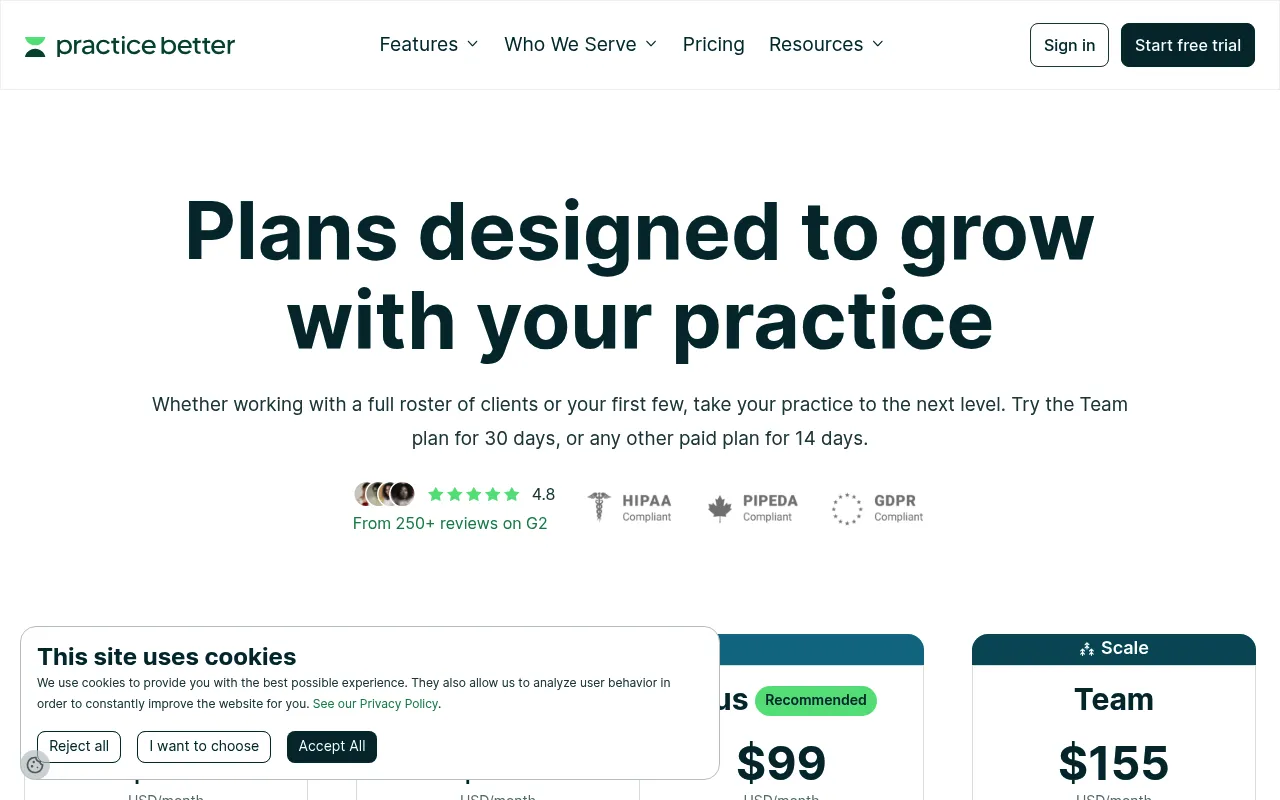
Pricing is tiered by client count. Starter is $35/month ($25/month yearly) for 10 clients. Professional is $69/month ($59/month yearly) for 300 clients. Plus is $99/month ($89/month yearly) with unlimited clients and 3 admins. Team starts at $155/month. Students and new grads get the free Sprout plan with 3 clients. Paid plans come with a 14-day trial (30 days on Team).
Pros
- Telehealth included from Starter
- Strong forms, protocols and client portal
- Free plan for students, cheap entry tier
- Superbills plus a Claim.MD integration
Cons
- Starter caps you at 10 clients
- Meal planning is a $15/month add-on
- Claims depth is lighter than Healthie's
Best for: solo dietitians in the US or Canada who want one tool for the whole client journey and bill insurance occasionally.
2. SimplePractice
Best for insurance-ready adminSimplePractice started in mental health and is now one of the most widely used practice management tools in the US. It's not nutrition-specific, but its scheduling, documentation, client portal and billing are mature.
Standard prices are $49/month for Starter, $79/month for Essential and $99/month for Plus, with extra practitioners at $74/month each. New accounts often see a 3-month half-price promo. Claim filing goes through the Insurance Navigator add-on, free for 30 days and then $1.79 per claim. The free trial runs 30 days.
Pros
- Mature scheduling and billing
- Per-claim pricing suits low claim volume
- Long 30-day trial
Cons
- No nutrition tools: no food journals or meal plans
- Note templates are therapy-first
- US-focused
Best for: US dietitians who care most about clean billing and scheduling and will handle nutrition content in a separate tool.
3. Kalix
Best budget EHRKalix is a lean EHR used by dietitians and allied health professionals in Australia, the UK and the US. Its Standard plan is $30/month ($300/year) and already includes charting and superbills. That's the lowest price in this list for a real EHR with no client cap.
The catch is telehealth. It only comes with Virtual Practice at $52/month ($520/year). Insurance claims are a $17/month add-on. Annual billing saves 15%, and you get a one-month free trial with no card.
Pros
- $30/month with superbills included
- No client limit on solo plans
- Simple, fast interface
- One-month trial
Cons
- Telehealth needs the $52 plan
- Claims cost $17/month extra
- Lighter nutrition tooling (food logging listed as coming soon)
Best for: cash-pay solo dietitians who want a proper EHR with superbills at the lowest monthly cost.
4. Nutrium
Best outside the USNutrium is built in Portugal and widely used across Europe and Latin America. It's nutrition-first: diet assessment and nutrient analysis, meal plans, a client app, scheduling and reminders, telehealth, and invoicing.
Billed yearly, the unlimited-clients plan is $25/month ($299/year) and the 10-clients-a-month plan is $15/month ($179/year). Monthly prices change with promotions, so see current pricing. Every plan has a 14-day free trial.
Pros
- Nutrient analysis and meal plans built in
- Low yearly price
- Fits European and Latin American practices
Cons
- No US insurance claim workflow
- Nutrium branding stays visible to clients
- Monthly pricing is hard to pin down
Best for: dietitians in Europe, Latin America or Canada who want clinical nutrition and practice admin in one tool.
5. NutriAdmin
Best nutrition-first budget pickNutriAdmin is a UK-built practice tool for nutritionists and dietitians. It combines meal plans and a nutritional database with intake forms, appointment slots, Google Calendar sync and automated reminders.
Basic is $34.99/month ($29.16/month yearly) for 10 new clients a month. Popular is $49.99/month and adds a recipe database, recipe import and Stripe payments. Professional is $74.99/month for 40 new clients a month. Telehealth is a separate add-on. Every plan has a 14-day trial.
Pros
- Meal plans included from Basic
- Prices in USD, GBP, EUR, CAD, AUD, NZD
- Good scheduling for the price
Cons
- Telehealth costs extra
- Caps on new clients per month
- No US insurance claim filing
Best for: cash-pay nutritionists who want meal plans and admin together and don't need insurance billing.
6. Jane
Best for multi-discipline clinicsJane is a Canadian practice management platform used by clinics that mix dietitians with physios, chiropractors or counselors. Booking, charting and 1:1 telehealth come with every plan.
On its pricing page, plans are Balance at CA$59/month, Practice at CA$79/month and Thrive at CA$99/month. US pricing varies by region, so see current pricing. Insurance billing is an add-on on Practice and Thrive. Jane doesn't offer a free trial, but you can explore a demo account.
Pros
- Excellent online booking
- Telehealth on every plan
- Built for clinics with several disciplines
Cons
- No free trial
- No meal planning or food journals
- More than a solo dietitian needs
Best for: dietitians working inside an allied health clinic that already books several practitioners.
7. Promealplan
Best meal-plan layer (not an EHR)Full disclosure: this is our product, and it isn't an EHR. Promealplan doesn't do charting, insurance billing, superbills or scheduling. So it's not competing for the "best EHR" slot.
What it does is build macro-focused meal plans fast. You set calories, protein, carbs and fat, and the algorithm hits each target within 2% per day using 1,000+ dietitian-validated recipes. The macro math is deterministic, not AI, and the recipes are created by dietitians. A plan takes about 5 minutes instead of 45 to 90 by hand. Clients get their meal plans, recipes and grocery lists in a client app, in English, French or Spanish.
Most dietitians use it next to their EHR: notes and billing in Practice Better, Kalix or Healthie, meal plans in Promealplan. If your practice mostly sells meal plans, it can be your main tool, since it also covers client profiles (goals, allergies, intolerances), intake forms and check-ins with body metrics and progress photos.
Pricing: Free (3 meal plans, no card), Lite $49/month, Basic $99/month, Pro $149/month with 3 seats, Scale $399/month with 5 seats. Lite removes Promealplan branding. Basic and above add your own logo, colors and fonts to PDFs and the client app. Rated 4.5/5 on Trustpilot. See how it compares with other dietitian meal planning software.
Pros
- Plans hit macros within 2% per day
- About 5 minutes per plan
- Your branding from Basic
- Free plan to test with real clients
Cons
- Not an EHR: no charting or notes
- No insurance billing, superbills or scheduling
- Macros only, no micronutrient analysis
Best for: dietitians whose EHR meal planner is too slow, and practices that mostly deliver macro-based meal plans.
Keep your EHR. Speed up your meal plans. Build a client plan in about 5 minutes that hits calories, protein, carbs and fat within 2% per day, from 1,000+ dietitian-validated recipes. Try it with 3 free meal plans, no credit card required.
Create 3 free meal plans →How do the Healthie alternatives compare feature by feature?
Every EHR here covers scheduling and client records. The real differences are telehealth, claims and nutrition tools. "Add-on" means you can get it, but you'll pay extra.
| Tool | Charting | Insurance claims | Telehealth | Meal plans |
|---|---|---|---|---|
| Healthie | Yes | Add-on (ClaimMD) | All plans | Basic |
| Practice Better | Yes | Superbills + Claim.MD | From Starter | Add-on $15/mo |
| SimplePractice | Yes | Add-on, $1.79/claim | Check plan | No |
| Kalix | Yes | Superbills + $17/mo add-on | From $52 plan | Limited |
| Nutrium | Yes | No US claims | Yes | Yes, with nutrient analysis |
| NutriAdmin | Client records | No | Add-on | Yes |
| Jane | Yes | Add-on (Practice+) | All plans | No |
| Promealplan | No | No | No | Yes, macros within 2%/day |
Features and prices verified November 2026 on each vendor's pricing page.
How much does a dietitian EHR really cost per month?
A solo dietitian usually pays $30 to $90 a month for an EHR once add-ons are counted. The sticker price rarely tells the full story. Here's what a typical solo setup with telehealth and some insurance billing costs on monthly billing.
- Kalix: $52 (Virtual Practice) + $17 claims = $69/month. Without claims, $52.
- Practice Better: $69 (Professional, 300 clients) + $15 Nutrition Planning = $84/month, before any claims service fee.
- Healthie: $49.99 (Essentials) + ClaimMD from about $25 to $30 = roughly $75 to $80/month.
- SimplePractice: $49 (Starter) + $1.79 per claim. At 20 claims a month, that's about $85/month. Check that your plan includes the telehealth you need.
Cash-pay and not billing insurance? The math gets much simpler. Kalix Standard at $30 with superbills, or Practice Better Starter at $35 for your first 10 clients, covers most new practices.
Add payment processing on top. It's charged per transaction on every platform here, so ask each vendor for its exact rate before you compare.
Should you use one platform or an EHR plus a meal planning tool?
Use one platform if meal plans are a small part of your work. Pair an EHR with a dedicated meal planning tool if you send more than a handful of plans a week. The built-in planners in most EHRs are fine for an occasional handout, but they get slow once plans become your main deliverable.
Here's a quick test. Count how many meal plans you built last month and multiply by the time each one took. At 45 to 90 minutes per plan by hand, 12 plans eat 9 to 18 hours. At about 5 minutes each, the same 12 plans take one hour. That gap is what you're paying for when you add a second tool.
A paired setup usually looks like this:
- EHR: intake, charting, booking, telehealth, superbills and claims. This is where your clinical record lives.
- Meal planning tool: macro targets, recipes, grocery lists and the client-facing plan. This is what your client opens every day.
The downside is two logins and two subscriptions. A solo dietitian on Kalix Standard ($30) plus Promealplan Lite ($49) pays $79 a month. That's in the same range as one EHR with add-ons, so compare the hours saved, not just the invoice.
One platform wins if you rarely write meal plans, you see clients mostly for counseling, or you'd rather accept a slower planner than manage two tools. Practice Better with its Nutrition Planning add-on, or Nutrium, are the strongest single-platform picks for that.
How do you switch from Healthie without losing client data?
Export everything before you cancel, run both tools in parallel for one billing cycle, and move active clients first. Most dietitians finish a switch in two to four weeks. These steps keep it calm.
- Export your records first. Download client lists, chart notes, documents and invoices while your Healthie account is still active. Ask support what formats they provide. Keep a dated copy you can reach if a payer or client asks for records later.
- Ask the new vendor about migration help. Several EHRs offer free or paid data import for client lists and documents. Get it in writing before you commit.
- Rebuild your intake forms. Copy questions over and test the form on yourself. Intake is the first thing new clients see, so don't let it break.
- Move active clients, archive the rest. Invite current clients to the new portal with a short note on why and what changes for them. Past clients can stay in your export.
- Overlap one billing cycle. Settle open invoices and pending claims in Healthie before you close it. Start new appointments in the new tool.
- Sign the BAA. If you see US clients, make sure your new vendor's Business Associate Agreement is signed before any client data moves.
Switching is also a good moment to check what you actually use. If you never touched Healthie's courses or group programs, don't pay for them in your next tool either.
Which Healthie alternative should you choose?
Match the tool to how your practice gets paid and where your clients live. Here's our verdict for each situation.
You bill US insurance every week
Verdict: stay on Healthie, or test SimplePractice. Healthie's claims workflow is the deepest here. SimplePractice is a good second look if you want mature billing with per-claim pricing.
You're a solo dietitian who wants one tool for everything
Verdict: Practice Better. Charting, booking, telehealth, programs and a client portal, starting at $35/month. It's the closest match to what Healthie offers solo practitioners, at a lower entry price.
You run a cash-pay practice on a tight budget
Verdict: Kalix. $30/month gets you charting and superbills with no client cap. Upgrade to $52 when you need telehealth.
You practice in Europe or Latin America
Verdict: Nutrium. Nutrition analysis, meal plans, telehealth and scheduling from $15/month billed yearly, built for markets outside the US.
You want meal plans and admin together, no insurance
Verdict: NutriAdmin. Meal plans from the $34.99 Basic plan, solid scheduling and multi-currency pricing.
You work in a clinic with other disciplines
Verdict: Jane. Excellent booking for multi-practitioner clinics, telehealth on every plan.
Your EHR's meal planner slows you down
Verdict: add Promealplan next to your EHR. Keep notes and billing where they are. Build macro-based plans in about 5 minutes. If meal plans are most of what you sell, it can stand on its own.
Not sure yet? Shortlist two tools, run your next three real clients through both trials, and time the full workflow from intake to follow-up note. The faster one wins.
Frequently Asked Questions
What is the best EHR for dietitians in 2026?
For most solo private-practice dietitians, Practice Better is the best all-round EHR: charting, scheduling, telehealth, client portal and payments from $35/month ($25/month billed yearly). If you bill insurance heavily in the US, Healthie (from $49.99/month) is the stronger claims tool. On a tight budget, Kalix starts at $30/month with superbills included. Prices checked November 2026.
What is the cheapest alternative to Healthie?
Among full EHRs, Kalix Standard is the cheapest at $30/month ($300/year) with charting and superbills, though telehealth needs the $52/month Virtual Practice plan. Practice Better Starter costs $25/month billed yearly but caps you at 10 clients. Nutrium starts at $15/month billed yearly for 10 clients a month. Practice Better also has a free Sprout plan for students and new grads (3 clients).
Which dietitian EHR handles insurance billing best?
Healthie is built around US insurance workflows, with CMS 1500 forms and a ClaimMD integration (sold as a paid add-on). SimplePractice offers claim filing through its Insurance Navigator add-on, billed per claim. Practice Better and Kalix both support superbills and connect to a claims service, which suits dietitians who bill some insurance but not all day, every day.
Is Promealplan an EHR?
No. Promealplan is a macro-focused meal planning tool. It doesn't do charting, insurance billing, superbills or scheduling. Dietitians use it alongside an EHR to build plans that hit calories, protein, carbs and fat within 2% per day, in about 5 minutes per plan, from 1,000+ dietitian-validated recipes. If your practice mostly delivers meal plans, it can be your main tool. There's a free plan with 3 meal plans, no card required.
Should I leave Healthie?
Stay if you bill US insurance at volume, run a group practice, or use its integrations and API. Healthie is still strong there. Consider switching if you're a solo dietitian who mostly takes cash-pay clients, practices outside the US, or pays for modules you never open. In that case Practice Better, Kalix or Nutrium usually cost less for the same daily workflow.
Give your clients better meal plans, in 5 minutes
Keep your EHR for notes and billing. Use Promealplan for macro-accurate meal plans, grocery lists and recipes your clients actually follow. Start with 3 free meal plans, no credit card required.
Create 3 free meal plans