HubFit Review 2026: All-in-One Power, AI-Generated Macros
HubFit promises one app for workouts, meal plans, habits, community, and a branded mobile app. With "thousands of coaches" and 350+ five-star Trustpilot reviews, the product is clearly working for its audience. The catch is what's hiding inside the meal planner. Here's what we found.

TL;DR
- → HubFit is a strong all-in-one platform: workouts, nutrition, habits, community, and a branded app, starting at $39/month.
- → Meal planning sits behind the Premium tier ($69/month) and uses AI generation that can produce hallucinated macros.
- → The 5,000+ recipe library is large but lacks public validation documentation.
- → English-first product. No native French or Spanish recipe sets.
- → If macro precision and dietitian-validated recipes matter, Promealplan handles meal planning more carefully. If your clients prefer one branded app for everything, HubFit is the smoother experience.
What Is HubFit?
HubFit is an all-in-one online coaching platform that serves personal trainers, online coaches, gyms, studios, health and wellness pros, content creators, and nutrition coaches. The pitch: one platform for training, nutrition, community, and business operations, delivered to clients through a branded mobile app on iOS and Android.
The company claims thousands of coaches on the platform, and a marketing figure of 50,000+ coaches gets cited across their materials. Trustpilot shows 350+ five-star reviews from coaches, with one widely-used testimonial from Jesse Astill of ASTL Performance: "Cut my admin time by 75%." The reviews skew positive, and most center on the time savings of having everything in one place.
HubFit's branded mobile app is a real differentiator. Existing examples include Her Heart Fit, Waypoint, VRise, Forge, and Bali. Your clients download an app with your name, your colors, and your logo, not a HubFit-branded app. For coaches who care about owning the client experience, this is one of the cleanest delivery models available below the enterprise tier.
HubFit Homepage
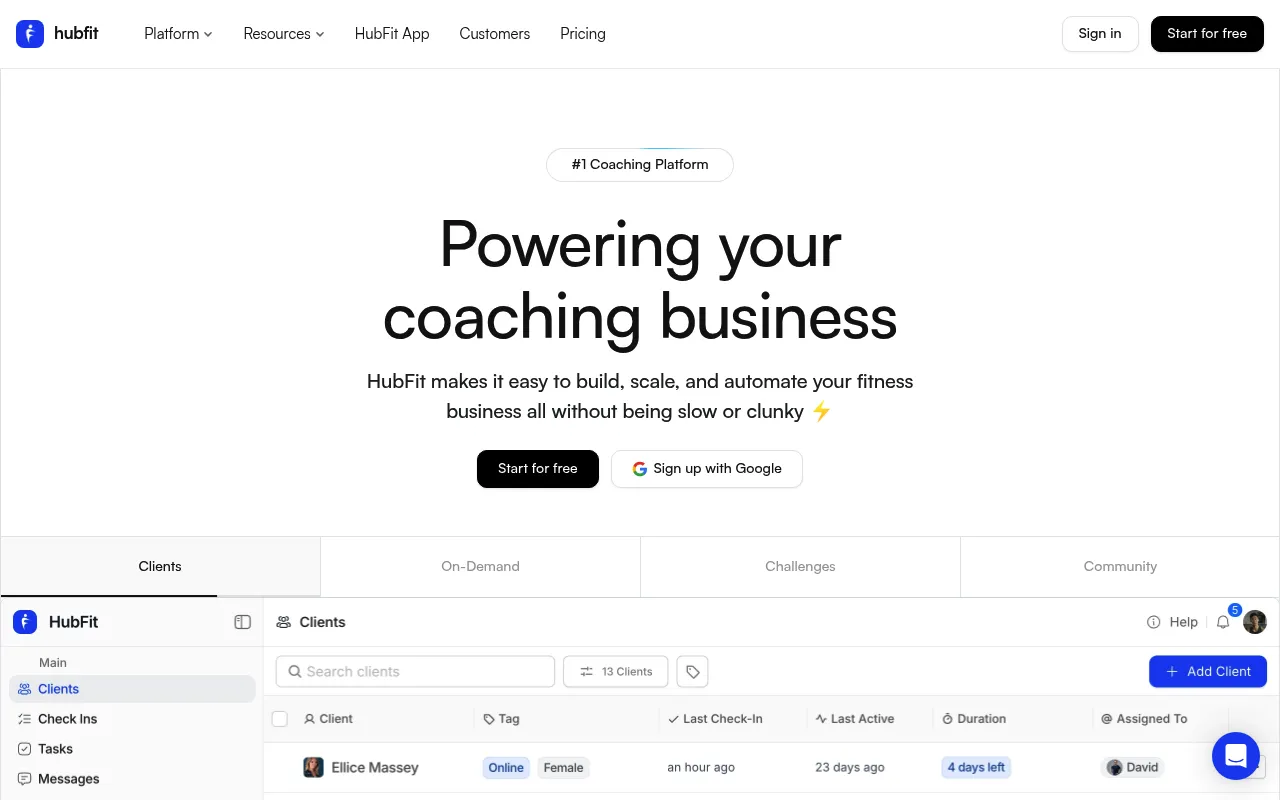
Screenshot captured May 2026 from hubfit.com.
How Much Does HubFit Cost in 2026?
HubFit has three tiers: Standard ($39/month), Premium ($69/month), and Ultimate ($119 to $419/month). All plans include a 14-day free trial with no credit card required. Annual billing gives you two months free, and there's no commitment beyond the billing period. The important part: meal planning lives in the Premium tier and above. Standard alone won't get you there.

Screenshot captured May 2026 from hubfit.com/pricing.
| Standard | Premium | Ultimate | |
|---|---|---|---|
| Monthly price | $39/mo | $69/mo | $119 to $419/mo |
| Client cap | Up to 50 | Up to 100 | 100 to 500 |
| Per-client cost (Ultimate) | — | — | $1.19 down to $0.84 |
| Workout builder | Yes (advanced) | Yes | Yes + Workout AI + Studio |
| Nutrition tracker | Yes | Yes | Yes |
| Smart meal planner | No | Yes | Yes |
| Meal AI | No | Yes | Yes |
| Recipe library | No | 5,000+ recipes | 5,000+ recipes |
| Custom branding | No | Yes | Yes |
| Payments + packages | No | Yes | Yes |
| Challenges | No | Yes | Yes |
| Community forums | No | No | Yes |
| Group chats | No | No | Yes |
| Team members | No | No | Yes |
| Zapier | No | No | Yes |
| Free trial | 14 days, no credit card. Annual billing saves two months. | ||
The pricing is competitive at the entry level. A solo coach with 30 to 50 clients on Premium pays $69/month for the full all-in-one experience including the branded app, which compares favorably to add-on-heavy competitors. The trade-off is that meal planning is locked behind Premium, so coaches who only need basic training and check-ins are paying for a tier they don't use.
What Are HubFit's Key Features?
HubFit covers four major areas: training, nutrition, engagement, and business. Here's the detailed breakdown of each, with extra attention to nutrition since that's where the comparison with Promealplan matters most.
Training: Workout building and exercise library
HubFit's workout builder supports multiple training styles: supersets, circuits, intervals, AMRAP, and standard sets and reps. Each exercise comes with a video demonstration, and clients see the full sequence inside their branded app. Ultimate adds Workout AI (auto-generated programs), workout studio for live classes, and the ability for team coaches to share program templates. The training side is solid and competitive with workout-first platforms.
Nutrition: Where the comparison gets interesting
Nutrition is split across three layers in HubFit. Standard includes the in-app nutrition tracker (clients log food with barcode scanning, search, or manual entry, and you see daily macros). Premium unlocks the smart meal planner (rule-based, builds plans from the recipe library) and meal AI (generative AI that produces meal ideas and full plans on demand). The recipe library claims 5,000+ entries, with filtering by dietary preference and basic allergens.
The honest assessment: barcode scanning and the recipe library are real advantages. Clients can scan a packaged food at the grocery store and log it in seconds, which is a usage pattern Promealplan doesn't currently support (Promealplan focuses on coach-built meal plans, not client food logging). The 5,000+ recipe library is also genuinely larger than what most dedicated nutrition tools offer.
The concern: the validation pipeline for HubFit's recipe library isn't publicly documented, and the meal AI is generative, which means it can produce meal plans with hallucinated portion sizes or nutrition values. AI nutrition math is a known weak spot industry-wide. Anthropic, OpenAI, and Google have all published examples of language models generating confidently wrong calorie counts. If macro precision is core to your service, this is the gap to know.
Engagement: Habits, check-ins, community, challenges
HubFit includes scheduled check-ins (daily, weekly, bi-weekly, monthly) with a dedicated inbox so client responses don't get lost. Habit tracking has a custom-built library plus pre-made habits you can assign. Premium adds challenges with live leaderboards and milestone badges. Ultimate adds community forums (an in-app social feed), group chats, broadcast messages, and threaded conversations. For coaches who want client-to-client connection inside the app, the engagement features are well-built.
Business: Payments, automations, integrations
Premium and above include integrated payments: one-time, recurring, trials, coupons, invoicing. Onboarding automations are available on Standard, while autoflow events (trigger-based automations like "send check-in 7 days after signup") and autoflow templates require Premium and Ultimate respectively. Ultimate also adds Zapier integration, opening the door to connecting HubFit with 5,000+ other apps. For coaches who want everything in one ecosystem, the business tools cover most needs without forcing third-party tools.
Want meal planning without AI guessing macros? Promealplan calculates portion sizes with a deterministic algorithm. Every recipe is dietitian-validated, never AI-generated. Start free with 3 plans, no credit card required.
Create 3 free meal plans →HubFit Strengths
We don't believe in trashing competitors. HubFit does several things genuinely well, and being honest about that helps you make a better decision. Here's what stands out.
- + All-in-one workflow. Workouts, nutrition, habits, check-ins, payments, community, all in one client experience. No tab switching, no copy-paste between tools.
- + 5,000+ recipe library. One of the larger libraries in coaching software. Clients with varied tastes won't run out of options.
- + Branded mobile app on iOS and Android. Clients download an app with your name and colors, not a HubFit-branded app. Real ownership of the client experience.
- + Barcode scanning for food logging. Clients scan packaged food at the grocery store. Saves real time on macro tracking compared to manual entry.
- + Built-in challenges and community. Live leaderboards, badges, group chats, and forums create social pressure that drives retention. Hard to replicate by stitching together separate tools.
HubFit Limitations
Where the platform falls short. These aren't dealbreakers for everyone, but they matter if your practice depends on the specific things HubFit doesn't prioritize.
- − Meal AI risks hallucinated macros. Generative AI is a known weak point for nutrition math across the industry. HubFit doesn't publish accuracy benchmarks, and the meal AI can produce plans with wrong portion sizes or calorie counts. Promealplan addresses this with a deterministic algorithm that calculates portions by math, not language model.
- − Recipe validation isn't documented. The 5,000+ library is large, but the validation process isn't published. Promealplan's smaller 1,000+ library is fully dietitian-validated, with every recipe reviewed by a human nutrition professional before going live.
- − Premium tier required for meal planning. Smart meal planner and meal AI are gated to the $69/month Premium tier. Coaches who only need meal planning, no community or workouts, end up paying for a bundle they don't use.
- − English-first product. The interface is English, and the recipe library is built around English-speaking markets. No native French or Spanish recipe sets. Coaches in France, Quebec, Mexico, or Spain who deliver in their local language often find the recipe library culturally off.
- − Bundled pricing. The all-in-one model means you pay for features you may never use. A coach who already has a community on Discord and a payments tool on Stripe is paying for HubFit's overlapping features regardless.
Who Is HubFit Best For?
HubFit is built for a specific kind of coach: one who wants everything in one app and is willing to accept a few trade-offs in exchange for the integrated experience. Here's who fits and who doesn't.
Great fit: Solo and medium coaches who want everything in one app
If you have 20 to 100 clients and want one tool for workouts, nutrition, habits, community, and payments, HubFit is one of the cleanest options on the market. The branded mobile app means your clients see your name, not a third-party platform's. You spend less time on admin and more on coaching.
Great fit: Coaches whose clients prefer in-app experiences over PDFs
If your clients are comfortable using mobile apps and prefer scanning barcodes, tracking habits, and chatting in-app to receiving emailed PDFs, HubFit's delivery model fits the behavior. The interactive experience is hard to match with a PDF-based tool.
Less ideal: Dietitians who need clinical-grade macro precision
If you're a registered dietitian, certified nutritionist, or work with clients where macros are a clinical tool (medical conditions, performance athletes, contest prep), the AI-generated meal planning is a risk. Generative AI hallucinates nutrition values, and HubFit doesn't publish accuracy data. A deterministic tool like Promealplan is the safer choice when precision matters.
Less ideal: Coaches who deliver branded PDF meal plans
Some coaches build their service around a polished PDF deliverable: branded, formatted, designed to feel professional. HubFit doesn't ship a comparable white-label PDF export. If the PDF is your product, Promealplan generates branded white-label PDFs as the primary delivery format.
Less ideal: Coaches in French-speaking or Spanish-speaking markets
If you serve clients in France, Quebec, Mexico, Spain, or any French- or Spanish-speaking market, HubFit's English-first content won't feel native. The recipe library is built for English-speaking palates, and the interface isn't fully localized. Promealplan ships three native locales (English, French, Spanish) with locale-specific recipes for each market.
HubFit vs Promealplan: How Do They Compare?
HubFit and Promealplan compete directly on meal planning, but they're built around different priorities. HubFit prioritizes the integrated all-in-one experience. Promealplan prioritizes meal-plan precision and dietitian validation. Here's the side-by-side.
| Feature | HubFit | Promealplan |
|---|---|---|
| Recipe count | 5,000+ | 1,000+ |
| Recipe validation | Not publicly documented | Every recipe dietitian-validated, never AI-generated |
| Macro calculation | AI generation (meal AI) | Deterministic algorithm |
| White-label delivery | Branded mobile app (iOS + Android) | Branded white-label PDF export |
| Allergen filters | Basic dietary preference filters | 200+ allergens and intolerances |
| Locales | English only | English, French, Spanish (locale-specific recipes) |
| Pricing for meal planning only | From $69/mo (Premium tier required) | Lower entry tier, free trial with no credit card |
| Best for | All-in-one coaching with branded app | Meal-plan-first coaches and dietitians |
| AI use | Meal AI + Workout AI (generative) | No AI in macro math; deterministic algorithm |
| Trustpilot | 350+ five-star reviews | 4.5★ rating |
| Use together? | Some coaches do. HubFit for the all-in-one client app, Promealplan for the actual meal plan creation. Generated PDFs sit in HubFit's resource vault. | |
When Each Wins
Choose HubFit if
- • You want one app for workouts, nutrition, habits, and community
- • Your clients prefer mobile-app delivery over PDFs
- • Recipe variety matters more than dietitian validation
- • You serve English-speaking clients primarily
Choose Promealplan if
- • Macro precision matters (clinical work, athletes, contest prep)
- • Recipe validation by a real dietitian is non-negotiable
- • You deliver white-label branded PDF meal plans
- • You serve French- or Spanish-speaking clients with locale-native content
Use both?
Yes, for coaches who want the all-in-one HubFit experience plus best-in-class meal planning. Build the meal plan in Promealplan with deterministic macros and dietitian-validated recipes, export as branded PDF, and deliver through HubFit's resource vault or branded app. You pay for two tools, but you stop compromising on either side.
Final Take
HubFit is a strong all-in-one coaching platform. The branded mobile app, the engagement features, the recipe library size, and the integrated workflow are real strengths. For solo and medium coaches who want everything in one tool with their own brand on the client app, HubFit is genuinely competitive with the best of its category.
The honest gap is meal planning precision. Generative AI is a known weak spot for nutrition math, and HubFit doesn't publish accuracy benchmarks for its meal AI. The 5,000+ recipe library is large, but the validation process isn't documented. For coaches whose primary deliverable is general training and engagement, this matters less. For dietitians and macro-focused coaches, it's the difference between a tool you can trust on a clinical case and a tool that occasionally produces wrong numbers.
Promealplan takes the opposite approach. Smaller library (1,000+ recipes), but every recipe dietitian-validated by a human nutrition professional. Deterministic macro calculation, not AI generation. White-label PDF as the primary delivery format. Three native locales (English, French, Spanish) with locale-specific recipes. The trade-off is variety in exchange for reliability.
Choose by your primary deliverable. If your business runs on the integrated client experience and the branded mobile app, HubFit wins. If meal-plan precision and dietitian validation define your service, Promealplan wins. Some coaches use both, getting HubFit's all-in-one experience plus Promealplan's meal-planning depth. Either way, the right answer depends on what your clients actually buy from you.
Frequently Asked Questions
How much does HubFit cost in 2026?
HubFit has three tiers, all billed monthly with a 14-day free trial. Standard is $39/month for up to 50 clients and includes the workout builder, nutrition tracker, check-ins, habit coaching, and onboarding automations. Premium is $69/month for up to 100 clients and adds the smart meal planner, meal AI, recipe books, custom branding, payments, and challenges. Ultimate runs $119 to $419/month depending on client count (100 to 500 clients, scaling at $1.19 down to $0.84 per client) and adds team members, group chats, community forums, broadcast messages, and Zapier. Annual billing gives you two months free.
Is HubFit's meal planner accurate?
HubFit's meal planning sits behind two layers. The smart meal planner is rule-based and reasonably accurate for daily macro targets when you stay inside the recipe library. The newer meal AI feature is generative AI, which means it can produce meal ideas with hallucinated portion sizes or nutrition values. For coaches who use macros as a clinical tool, this matters. AI nutrition math is a known weak spot across the industry, and HubFit doesn't publish its accuracy benchmarks. If macro precision is core to your service, a deterministic meal planner like Promealplan calculates portion sizes by algorithm, not language model.
Does HubFit have dietitian-validated recipes?
HubFit advertises 5,000+ recipes in its library, which is one of the larger libraries in the coaching software space. The validation process is not publicly documented, and recipes appear to mix curated entries with user-submitted and AI-generated content. Promealplan takes the opposite approach with a smaller library of 1,000+ recipes where every recipe is human-validated by a dietitian before going live. Quantity vs validation is the trade-off, and the right choice depends on whether your clients trust a curated library or want maximum variety.
Can I use HubFit and Promealplan together?
Yes. Some coaches pair the two: HubFit for the all-in-one client experience (workouts, habits, community, branded app) and Promealplan for the actual meal plan creation with deterministic macros, 200+ allergen filters, and white-label PDF delivery. The PDFs you generate in Promealplan can sit inside HubFit's resource vault or get sent to the client by email. You pay for two tools, but you stop compromising on either side.
Does HubFit support French and Spanish locales?
HubFit is English-first. The interface is in English, and the recipe library is built around English-speaking markets. There's no native French or Spanish recipe set adapted to local ingredients, cuisines, or measurement conventions. Coaches in France, Quebec, Mexico, or Spain who deliver in their local language often find the recipe library culturally off. Promealplan ships three native locales (English, French, Spanish) with locale-specific recipes built for each market.
What's the difference between HubFit Standard, Premium, and Ultimate?
Standard ($39/mo, up to 50 clients) covers training, basic nutrition tracking, check-ins, and habits. Premium ($69/mo, up to 100 clients) is where the actual meal planning lives: smart meal planner, meal AI, recipe books, custom branding, payments, and challenges. Ultimate ($119 to $419/mo, 100 to 500 clients) adds team features for studios with multiple coaches, plus group chats, community forums, broadcast messaging, and Zapier integration. If meal planning matters, you need at least Premium. Standard alone won't cut it.
Macro Precision, Without the AI Guesswork
Promealplan calculates portion sizes with a deterministic algorithm. Every recipe is dietitian-validated, never AI-generated. White-label PDF, 200+ allergen filters, three native locales. Start free with 3 plans.
Create 3 free meal plansRelated Articles
Everfit Review 2026: Strong on Workouts, Weak on Nutrition
Honest breakdown of Everfit's pricing, hidden add-ons, and where its meal planner falls short.
Foodzilla Review 2026
A deep look at Foodzilla's recipes, pricing, and how it stacks up for nutrition coaches.
5 Best Meal Planning Software for Coaches (2026)
Compare Promealplan, That Clean Life, Nutrium, Eat This Much, and NutriAdmin side by side.
Best Meal Planning Apps 2026: Software Comparison for Coaches
Compare consumer apps, all-in-one platforms, and dedicated meal planning software.