Meal Planning Software for Health Coaches and Corporate Wellness Programs
Two very different buyers search for the same thing. A solo health coach wants a fast, branded tool to deliver plans to 15 clients. A corporate wellness manager wants to deploy nutrition support to 5,000 employees. Most software serves one well, not both. Here's how six platforms actually compare for each use case.

If you searched for meal planning software for health coaches, you're probably one of two people. Either you're a solo coach building plans for paying clients, or you run a wellness program for an employer who wants better outcomes from their workforce. The features you need barely overlap.
A solo coach measures success by client retention and the look of a branded PDF. A corporate program manager measures success by participation rate, engagement minutes, and dollars saved on health claims. The first wants a $49 per month tool with 1,000+ recipes. The second wants a quote, an admin console, and SSO.
This guide is split accordingly. We compare six platforms across both use cases, then pick the best fit for each persona at the end. All pricing was verified May 2026.
What a Solo Health Coach Actually Needs
A solo health coach typically runs 10 to 30 clients in 6 to 12 week packages, charges $200 to $600 per month per client, and treats nutrition as one piece of a larger coaching arrangement. The right software disappears from the client's view, makes you look polished, and saves you the 45 minutes a hand-built plan takes.
Speed over depth
You don't need a 25-micronutrient panel. You need calories, protein, carbs, and fat, generated in 5 minutes flat. Anything more complex pulls you back into spreadsheet work, which is what software is supposed to eliminate.
White-label that's actually white
When a client opens their plan, they should see your logo, your colors, and nothing else. Some tools say "white-label" but stamp their brand on the client app. That defeats the purpose. Test the client experience before buying, not the coach experience.
Per-coach pricing, not per-client
Some platforms charge per active client, which punishes growth. A flat per-coach fee scales better. As a rule, if pricing tiers are based on client count, model out 30 clients before signing up. The $17 per month plan often becomes $200 per month at scale.
A free or trial plan to validate
Before paying, you should be able to send at least one branded plan to a real client and see if they actually use it. Tools that gate the white-label feature behind paid tiers force you to commit before validating.
What a Corporate Wellness Program Actually Needs
Corporate wellness has a completely different buying process. You're typically a benefits manager, an HR director, or a wellness program lead, sourcing tools that 500 to 50,000 employees will use. Procurement, security review, and integration with the existing benefits stack matter more than recipe count.
Bulk seats and SSO
You need to provision thousands of accounts at once, ideally through SAML or Okta. Per-seat licensing should drop sharply at volume. Anything that requires individual signup defeats the rollout plan.
Engagement reporting at scale
Your CFO will ask three questions: how many employees activated, how often they used it, and what changed in the health-claim trend. The platform needs aggregate dashboards, not just per-coach client views. Without reporting, you can't renew the contract.
Privacy and compliance
If your employees' health data lives on the platform, you're looking at SOC 2 Type II minimum, often HIPAA. Corporate wellness vendors should publish their compliance certifications without a sales call. If they can't, that's a signal.
Integration with the broader benefits stack
Most large employers already run a wellness platform (Virgin Pulse, Wellable, Limeade). The meal planning piece needs to plug in via API or single sign-on, not become a separate login. Standalone meal apps with no integration story rarely survive procurement.
Six Platforms Compared for Both Personas
Each platform is rated for solo coach fit and corporate wellness fit separately, with honest pros and cons. Pricing was checked May 2026 from each vendor's public pricing page.
1. Promealplan: best for solo health coaches without a nutrition degree
Promealplan generates a complete macro-matched plan in about 5 minutes, with white-label branding on the free tier and a 1,000+ recipe library built by dietitians. The whole thing is engineered around the solo coach workflow: open the app, set the client's targets, generate, brand, deliver.
Pros
- White-label on every plan, including the free tier
- 1,000+ dietitian-built recipes with verified macro data
- Available in English, French, and Spanish for multilingual rosters
- Free plan with 3 meal plans, no credit card required
- 4.5 star rating on Trustpilot from coach reviews
Cons
- No corporate wellness tier or SSO integration
- Macro-focused, so it isn't built for clinical micronutrient work
- Smaller recipe library than That Clean Life
Pricing: Free / $49 per month. Best fit: solo coach.
2. Practice Better: best for coaches who also need scheduling and billing
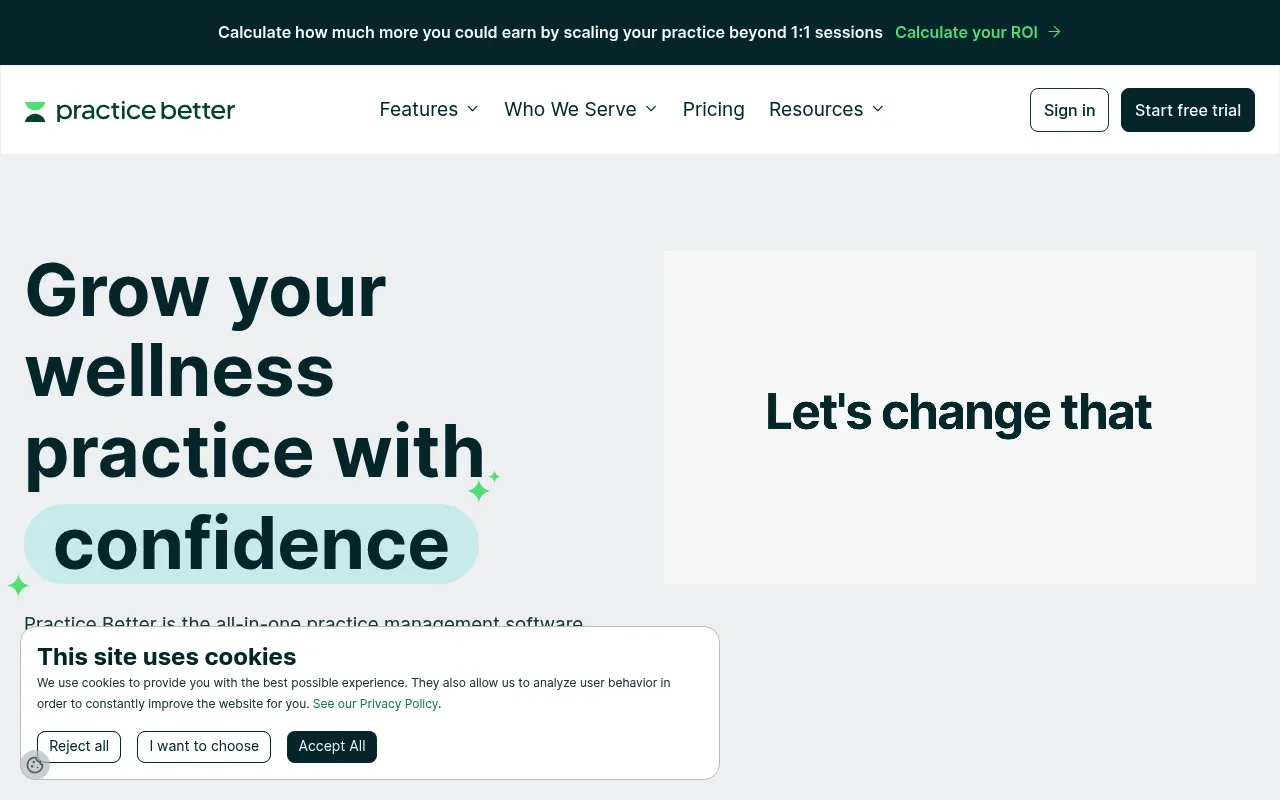
Practice Better is a full practice management platform with scheduling, intake forms, billing, telehealth, and a meal planning module. Solo coaches who want everything in one tool find it useful. The meal planning piece is less specialized than dedicated tools, and pricing climbs quickly past the entry tier.
Pros
- Scheduling, billing, telehealth, and forms in one platform
- HIPAA-compliant for coaches working in clinical settings
- Strong supplement and lab integrations
Cons
- Meal planning is shallower than dedicated tools (smaller recipe library, less templating)
- White-labeling locked behind upper tiers
- Pricing jumps from $35 to $99 quickly once you need feature add-ons
Pricing: Sprout (free), Starter $35/mo, Professional $69/mo, Plus $99/mo, Team $155/mo. Best fit: solo coach who also bills insurance.
3. That Clean Life: best for recipe variety and condition-specific plans
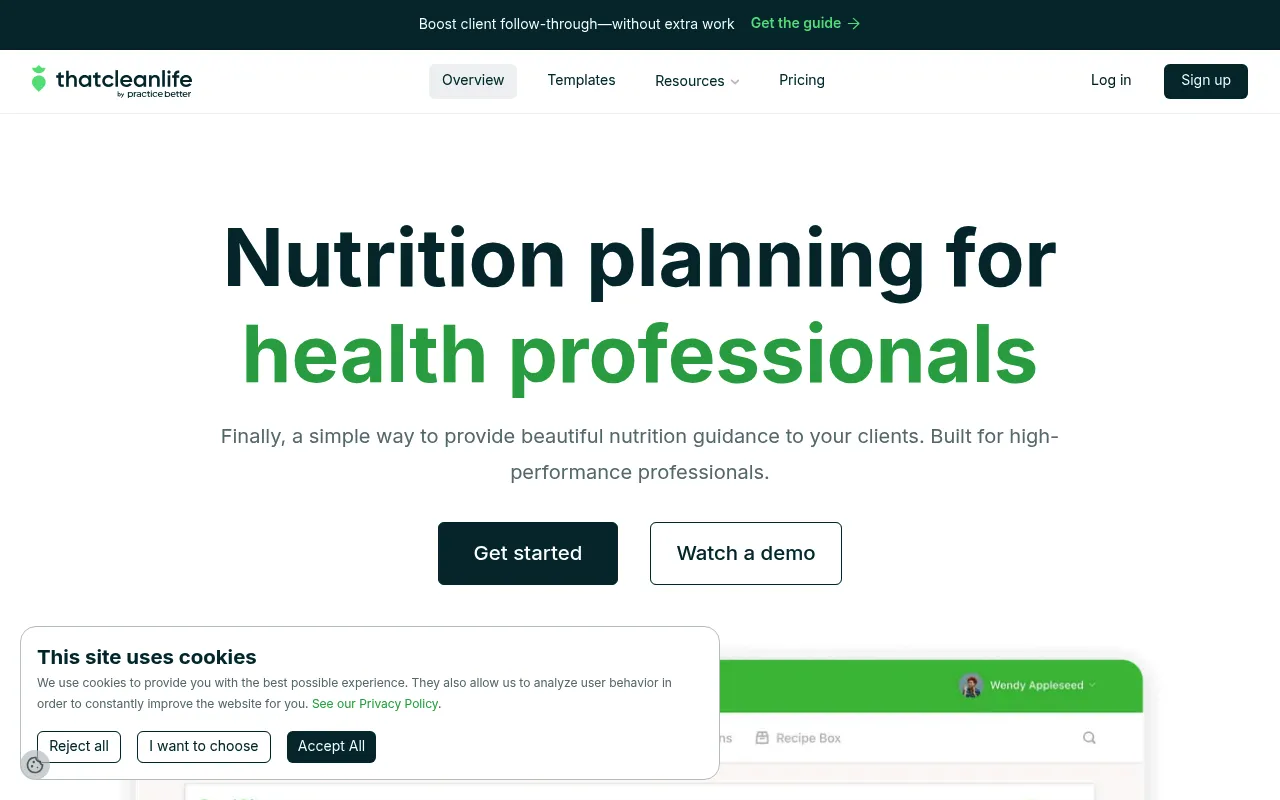
That Clean Life has the largest recipe library in the category at 8,000+ recipes, with condition-specific templates for anti-inflammatory, gut health, PCOS, and hormone support. It leans more clinical than Promealplan but stays accessible to non-dietitians. The volume of recipes is the main draw.
Pros
- 8,000+ recipes, the largest in this comparison
- Condition-specific templates (anti-inflammatory, PCOS, gut health)
- Branded PDF or shareable link delivery
Cons
- English only, no French or Spanish
- No real corporate wellness or SSO tier
- Less flexible than macro-target tools for athletic clients
Pricing: From $30 per month. Best fit: solo coach with condition-specific niches.
4. Healthie: best for group coaching and clinical workflows
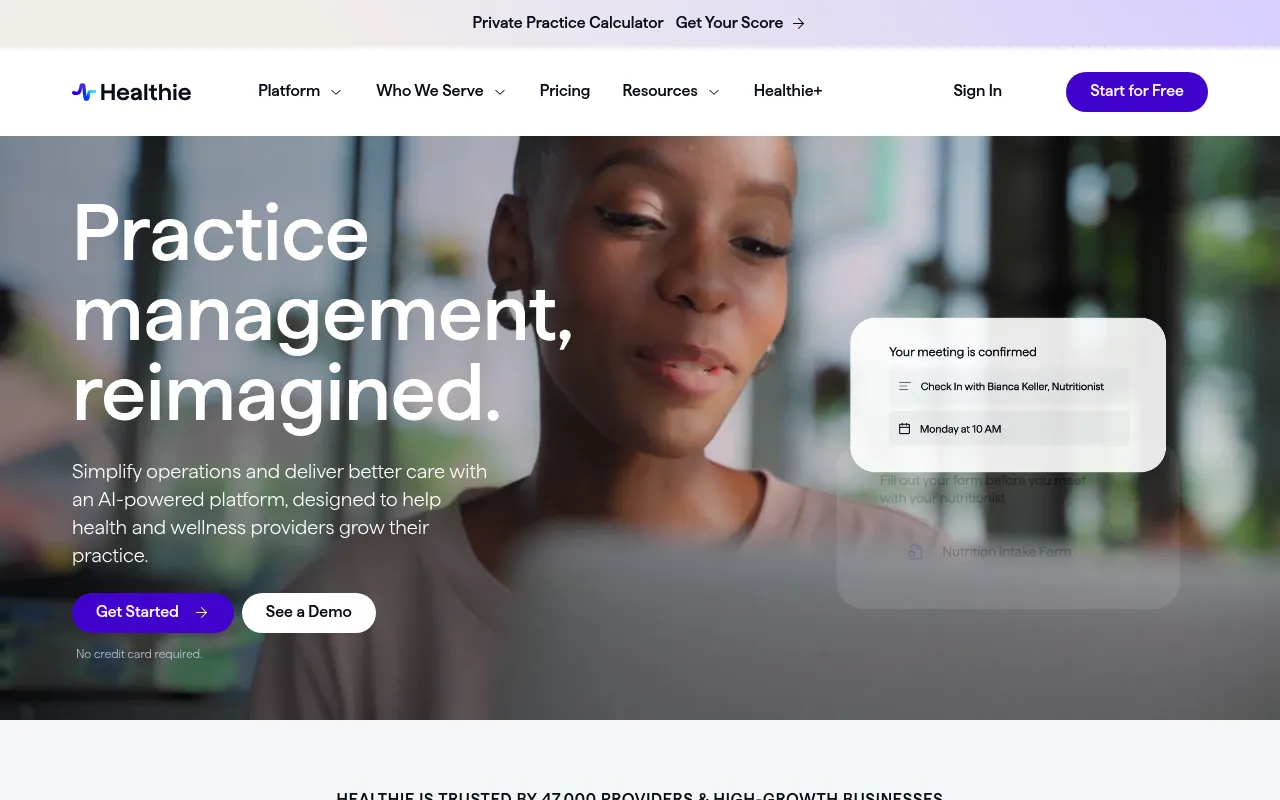
Healthie is a comprehensive EHR-style platform with strong group coaching features, wearable integrations including Dexcom CGM, and HIPAA compliance baked in. It's geared more toward dietitians and clinical practices than pure health coaches, but it does have a small business tier that works for solo coaches doing group programs.
Pros
- Group coaching features (cohorts, courses, shared resources)
- Wearable integrations including Dexcom CGM
- HIPAA-compliant by default, suits clinical settings
Cons
- Meal planning is a feature, not the focus, recipes are limited
- Pricing scales fast for multi-coach teams
- Overkill for a solo coach who just wants meal plans
Pricing: Essentials $49/mo, Plus $129/mo, Group $149/mo. Best fit: clinical practice or group coaching.
5. Foodsmart: best for corporate wellness with a food-as-medicine focus
Foodsmart is a B2B nutrition platform sold to employers and health plans, not individual coaches. It bundles dietitian-led telenutrition, personalized meal plans, food benefits, and grocery integrations. If you're sourcing for a corporate wellness program with thousands of employees, this is the kind of vendor your benefits broker will surface.
Pros
- Built for enterprise from day one (SSO, admin controls, reporting)
- Includes virtual dietitian sessions, not just software
- Integrates with grocery delivery and food benefits programs
Cons
- Not available to solo health coaches (no individual tier)
- Pricing is quote-based, multi-year contract typical
- Brand is theirs, not yours, no white-label for the employer
Pricing: Quote-based, employer contracts only. Best fit: corporate wellness teams.
6. Wellable: best for corporate wellness with broad lifestyle coverage
Wellable is a broad employee wellness platform that covers nutrition, fitness, mental health, and challenges in one stack. Meal logging happens through partner apps or native, with nutrient breakdowns and barcode scanning. It's the platform a 500-to-5,000-employee company picks when they want one wellness vendor instead of five.
Pros
- One platform for nutrition, movement, mental health, and challenges
- Aggregate engagement dashboards for HR and benefits teams
- Plays well with existing benefits stacks (integrations available)
Cons
- Meal planning is a feature, not the focus, no built-in recipe generation
- Not available to solo coaches
- Cost only makes sense above 200 to 300 employees
Pricing: Quote-based, employer contracts. Best fit: mid-to-large corporate wellness.
Feature Comparison at a Glance
The first three columns target solo coaches. The last two target corporate wellness teams. Healthie sits in the middle for clinical coaching.
| Feature | Promealplan | Practice Better | That Clean Life | Healthie | Foodsmart | Wellable |
|---|---|---|---|---|---|---|
| Best for | Solo coach | Solo + clinical | Solo coach | Group/clinical | Corporate | Corporate |
| Starting price | Free / $49 | $35/mo | $30/mo | $49/mo | Quote | Quote |
| White-label | Yes (free tier) | Paid tiers | Yes | Paid tiers | Vendor brand | Configurable |
| Recipe library | 1,000+ | Limited | 8,000+ | Limited | Curated | Via partners |
| SSO / bulk seats | No | No | No | Limited | Yes | Yes |
| HIPAA-compliant | No (not needed) | Yes | No | Yes | Yes | Yes |
| Engagement reports | Basic | Per-client | Per-client | Per-client | Aggregate | Aggregate |
| Languages | EN, FR, ES | EN | EN | EN | EN, ES | Multi |
| Free option | Yes | Sprout (limited) | Trial only | Trial only | No | No |
If you're a solo health coach, start free
Build your first white-label meal plan in 5 minutes. 1,000+ dietitian-built recipes. No credit card.
Create 3 free meal plans →Best for Solo Health Coaches
For a solo coach running 10 to 30 clients, the right pick depends on what else you need beyond meal planning.
If you want speed and white-label on day one: Promealplan
Generate a complete macro-matched plan in about 5 minutes. White-label is on the free tier, so you can validate with a real client before paying. The 1,000+ recipes are dietitian-built, so you don't second-guess the macros.
If you also want scheduling and billing: Practice Better
Best when meal planning is one of five things you need. The all-in-one tradeoff: meal planning depth is sacrificed for breadth. Good for coaches who already use a separate scheduling tool and want to consolidate.
If you specialize in conditions like PCOS or gut health: That Clean Life
The 8,000+ recipe library and condition-specific templates are unmatched if your roster skews toward clients with specific dietary protocols. Less suited for athletic or pure macro-tracking work.
If you run group programs or work in a clinical setting: Healthie
Group coaching features (cohorts, courses) and HIPAA compliance suit clinical and group programs. Overkill if you only run one-on-one coaching with 15 clients.
Best for Corporate Wellness Programs
Corporate wellness procurement is a different sport. You're picking a vendor for 500 to 50,000 employees, and recipe count rarely makes the shortlist.
If nutrition is the centerpiece: Foodsmart
Built specifically for employer-sponsored nutrition benefits, including telenutrition with credentialed dietitians, food benefit cards, and grocery integration. The right pick when nutrition is a strategic priority of the program, not a checkbox.
If nutrition is one piece of a broader wellness program: Wellable
Covers nutrition, movement, mental health, and challenges in one platform with aggregate reporting that makes renewal conversations easier. Pick this when you want one wellness vendor instead of stitching multiple together.
If you're under 100 employees: don't buy a corporate platform
Honest take: at small headcount, the per-employee math on enterprise vendors rarely works. A simpler approach is to hire one health coach (or contract one) and equip them with a tool like Promealplan, then let them deliver plans to interested employees on request.
How Solo Health Coaches Use Promealplan
Most health coaches aren't dietitians. They don't need software that tracks 40 micronutrients. They need a tool that takes a client's macro targets and produces a professional plan they're proud to send. Here's the actual workflow.
The recipes do the nutritional math
Every recipe in the library is dietitian-built with verified macro data per serving. You set the client's calorie target and macro split, and the plan is built from recipes that hit those numbers. You don't run calculations.
White-label means it's actually your brand
Every plan a client receives shows your logo, your colors, your name. No mention of Promealplan anywhere. PDF or client portal, the experience feels like your own product.
Free tier means you validate before paying
3 meal plans, full white-label, no credit card. You can deliver a real plan to your next client today, see how they react, then upgrade only if it's working.
Why coaches care: the time you spend formatting a plan in Word or Pinterest is time you don't spend coaching. Promealplan moves that hour into the coaching conversation, where your value actually lives.
Related Reading
Frequently Asked Questions
What's the difference between meal planning software for a solo coach vs a corporate wellness program?
Can health coaches use meal planning software without a nutrition certification?
How do corporate wellness teams use meal planning software at scale?
What's the cheapest way for a solo health coach to start offering meal plans?
Can clients see the meal planning software brand on their plan?
Do I need an EHR or HIPAA-compliant tool as a health coach?
Pick the Tool That Fits Your Buyer
Solo health coaches and corporate wellness teams shouldn't share a tool. The first wants speed, branding, and a $49 per month price tag. The second wants enterprise procurement, SSO, and aggregate reporting. Pick the side you're on, then pick the tool built for that side.
If you're a solo coach, the fastest way to find out if a meal planning tool fits your workflow is to send a real branded plan to a real client. Promealplan's free tier was built specifically for that test.
Build your first white-label meal plan in 5 minutes
1,000+ dietitian-built recipes. White-label on every plan. Free to start.
Create 3 free meal plans →