Meal Planning Software for Nutritionists: 6 Tools Compared
Most nutritionists spend 30 to 60 minutes building each client's meal plan by hand. Multiply that by 15 clients a week and you have lost an entire workday to spreadsheets and food databases. The right software cuts that to under 5 minutes per plan. The wrong one adds a billing line that doesn't pay for itself.

This guide compares the six meal planning tools nutritionists actually consider in 2026. Real pricing pulled this month. Real screenshots of every product's pricing page so you can see the catch before you sign up. Honest pros and cons for each, including where Promealplan falls short.
Two things shape the recommendation: what kind of nutritionist you are, and what your client deliverable looks like. A private-practice nutritionist serving fitness clients does not need the same toolset as a clinical nutritionist working inside a hospital. So we'll split the answer accordingly, then walk through each tool with screenshots, pricing, what it does well, and where it disappoints.
TL;DR. If you want fast macro-focused plans with white-label branding from day one, Promealplan is the cheapest path that includes branding on the free plan. If you want the largest recipe library and clinical templates, That Clean Life. If you want one platform for scheduling plus nutrition and you're HIPAA-bound, Nutrium. If you want a custom branded mobile app, Foodzilla Professional. If you just need practice management and you'll bolt on meal plans separately, Practice Better.
Two Types of Nutritionist, Two Different Software Stacks
The job title hides a real split. Most software comparisons miss this and recommend the same tool to everyone. They shouldn't. The right pick depends on which side of the line you sit on.
Private-practice nutritionist
Fitness, wellness, sports nutrition, online coaching
You build plans for paying clients who pay you directly. Your clients are healthy adults working on weight, performance, or general health. You bill out of pocket, not through insurance.
What you need:
- Macro-focused plans (calories, protein, carbs, fat)
- White-label branding so the plan feels yours
- Fast generation (under 5 minutes per plan)
- Allergy and preference handling at scale
Best fit: Promealplan, That Clean Life, Foodzilla.
Clinical or employed nutritionist
Hospital, medical office, insurance-billed
You work inside a healthcare organization or accept insurance. You need protected health information handled correctly. Charting, scheduling, and clinical notes matter as much as the meal plan itself.
What you need:
- HIPAA-compliant infrastructure (signed BAA)
- Micronutrient analysis (vitamins, minerals)
- Charting, scheduling, telehealth in one place
- Optional integration with EHR systems
Best fit: Nutrium, Practice Better, Cronometer Pro.
Promealplan is purpose-built for the first group. We say so up front because if you're billing insurance and treating chronic conditions, our recipe library and macro engine won't replace what Nutrium offers. Read this whole article before you decide.
What Nutritionists Actually Need in Meal Planning Software
Consumer calorie trackers and generic coaching platforms fall short for nutritionists. You need tools built for creating plans for other people, not logging your own food. Five things separate professional meal planning software from everything else.
Recipe database with verified nutritional data
Every recipe needs accurate per-serving calorie and macro breakdowns. User-submitted databases introduce liability. Professionally crafted recipes with verified data protect your reputation and your clients. If a client's macros are off because the database was wrong, the complaint lands on you, not the software.
Macro and calorie target customization per client
Set calories, protein, carbs, and fat targets for each client individually. The software adjusts recipe portions to hit those numbers. No more manual math every time you swap a recipe. The Promealplan algorithm targets within 2% accuracy per day, which is closer than most coaches can hit by hand.
Allergen and dietary restriction handling
Filter recipes by allergens (nuts, dairy, shellfish, soy), intolerances, and preferences (vegan, vegetarian, pescatarian, halal). With 200+ possible combinations across a roster of clients, doing this manually is slow and error-prone. One missed nut allergy is the kind of mistake that ends a client relationship.
Client portal or branded PDF delivery
Your clients need a professional way to access their plan, browse recipes, and view their grocery list. A branded portal or PDF keeps everything under your name, not a third-party app. Most clients don't read 30-page documents. They want a phone-friendly view of what to eat tomorrow.
White-label branding
Your logo, your colors, your practice name on every deliverable. Clients associate the quality of the plan with your expertise, which is the entire point of charging for nutrition services. A plan that says "Powered by SoftwareName" trains your client to remember the software, not you.
Test it with a real client today
Generate a personalized, white-label meal plan in under 5 minutes. 1,000+ dietitian-validated recipes. Free plan, no credit card required.
Create 3 free meal plans →The 6 Best Meal Planning Software for Nutritionists
Each tool below serves a different type of nutritionist. We pulled current pricing this month, included a homepage and pricing screenshot for each, and listed real pros and cons. The order does not imply ranking. Read the "best for" line under each name to find the match for your practice.
1. Promealplan
Best for macro-focused private-practice nutritionists
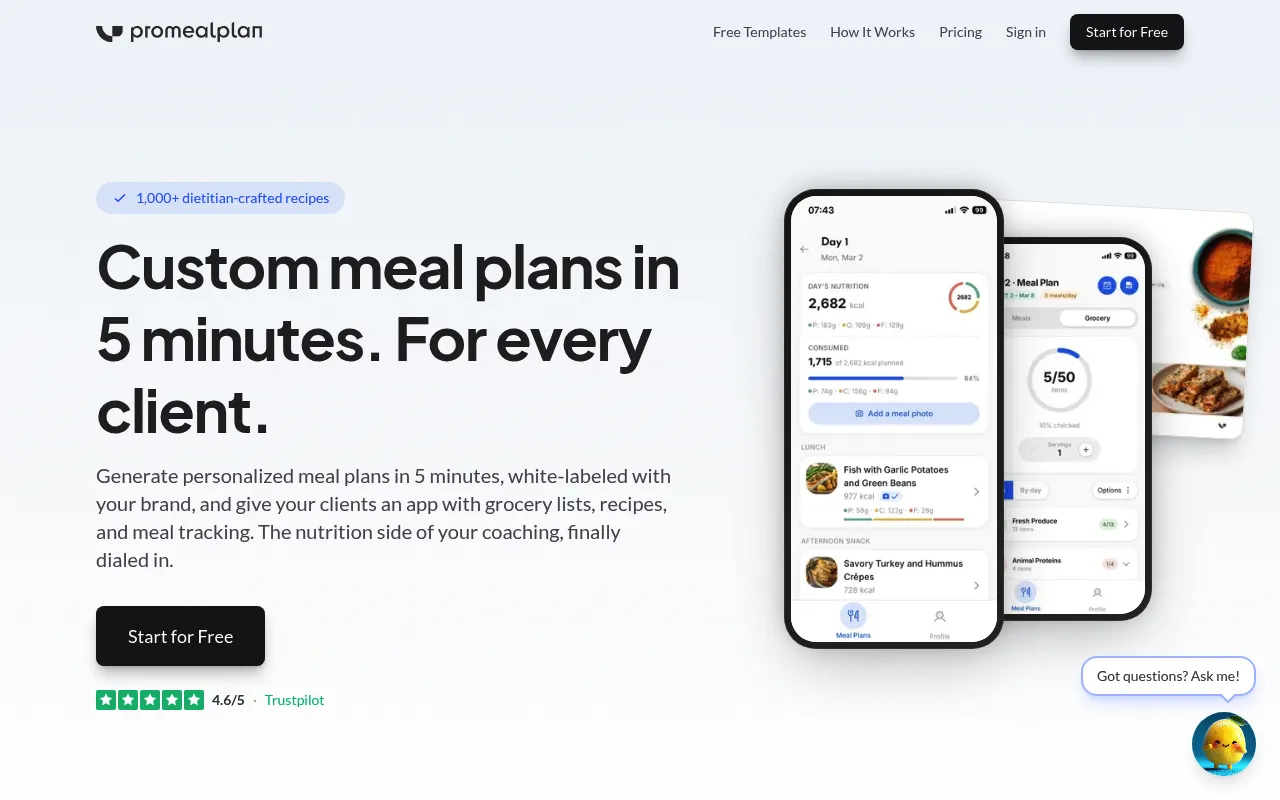
Promealplan is built for nutritionists and coaches who work primarily with macros. Set your client's calorie and macro targets, apply dietary restrictions, generate a complete weekly plan with recipes and a grocery list. Every plan is white-labeled with your branding, including the Free tier. The algorithm hits macro targets within 2% per day across 1,000+ dietitian-validated recipes. Rated 4.5 stars on Trustpilot by coaches across the US, France, and Spain.
Pros
- White-label branding on every tier, including Free
- Plans generate in under 5 minutes
- Recipes created by registered dietitians, not crowdsourced
- 3 client languages (English, French, Spanish)
- Macro targeting accurate within 2% per day
Cons
- No micronutrient tracking (macros only)
- No built-in scheduling or telehealth
- Smaller recipe count than That Clean Life
- Not HIPAA-compliant for clinical use
Pricing: Free (3 plans lifetime, no credit card), Lite $49/mo, Basic $99/mo, Pro $149/mo. Annual billing saves ~17%.
2. That Clean Life
Best recipe library and clinical templates
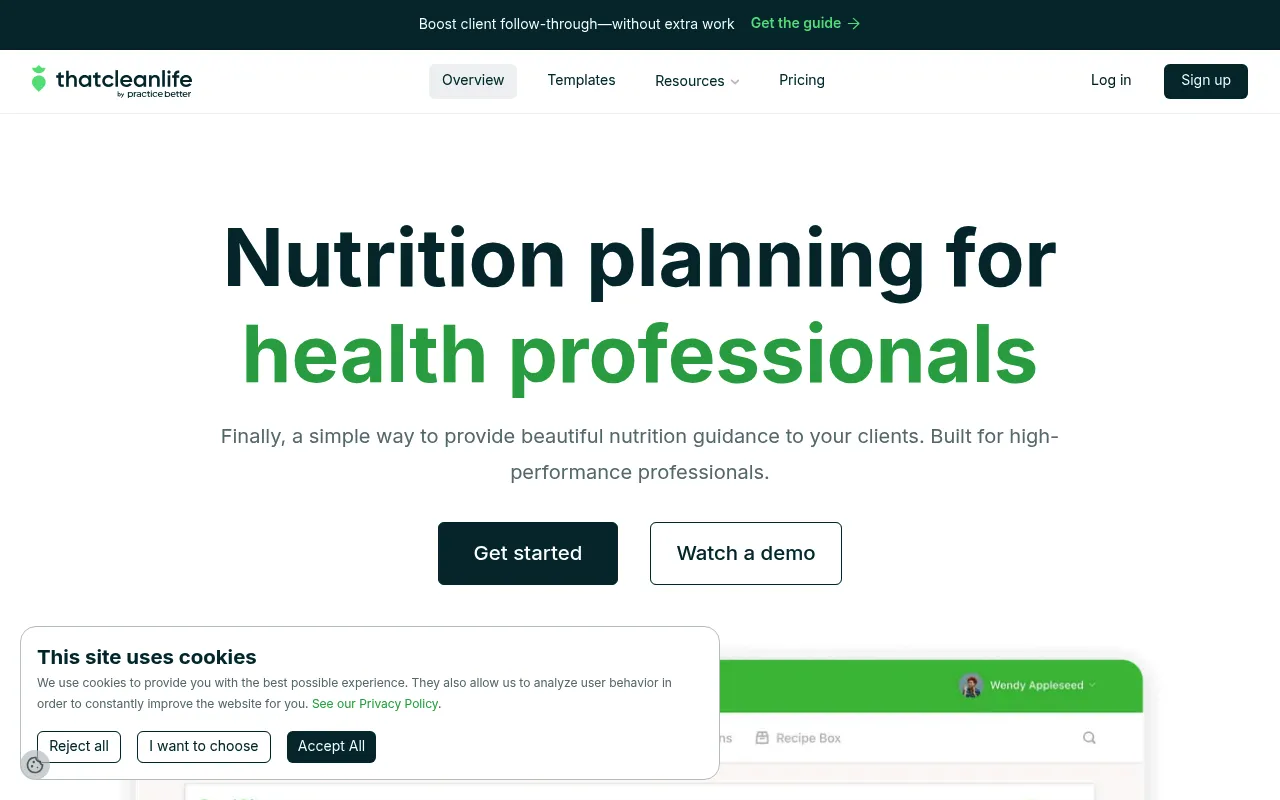
That Clean Life has one of the largest recipe databases in the space, with 8,000+ recipes and condition-specific meal plan templates (IBS, diabetes, PCOS, anti-inflammatory). It's popular with dietitians and nutritionists who need clinical templates out of the box without building them from scratch. The drag-and-drop plan builder is widely praised. Practice Better integrates it directly, which tells you something about how the market views it.
Pros
- 8,000+ recipes, the largest in the category
- Condition-specific templates ready to use
- Drag-and-drop plan builder is genuinely good
- Instacart integration for grocery delivery
- Strong client portal with recipe access
Cons
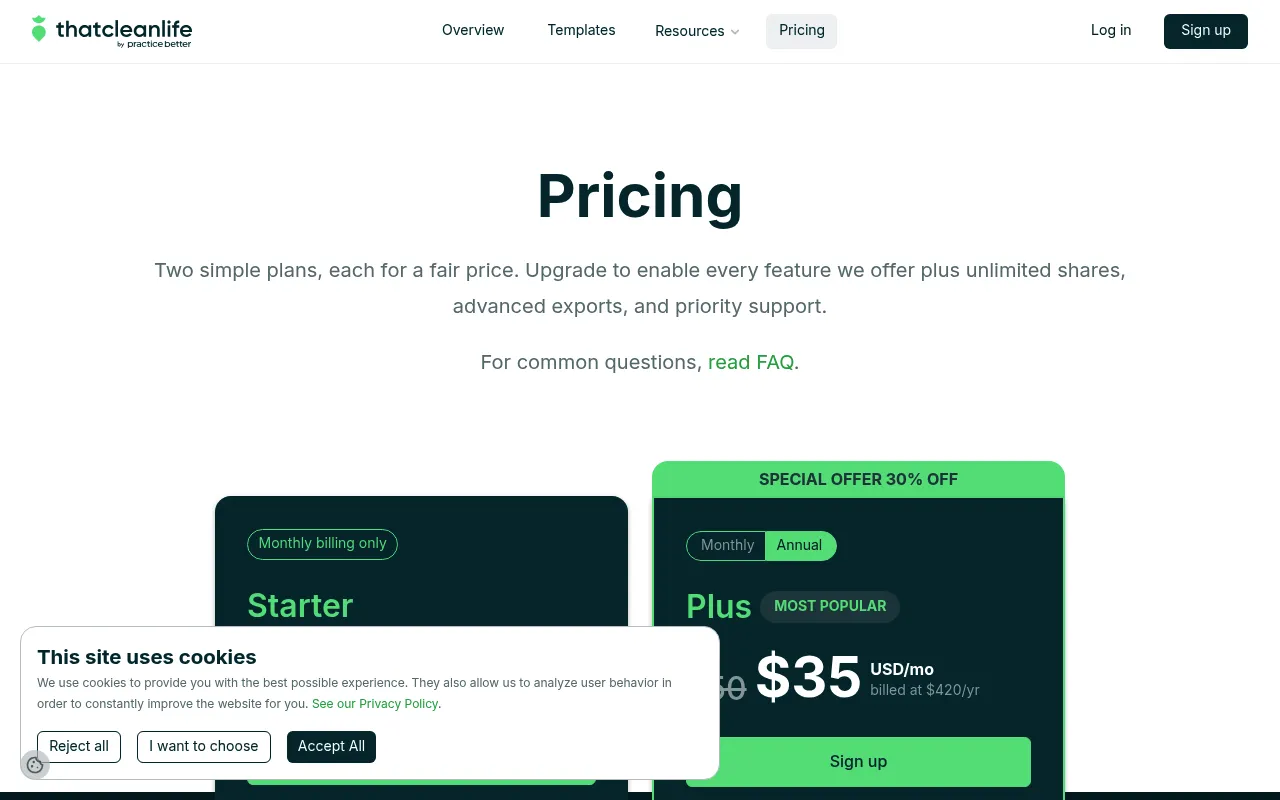
- White-label gated behind the $60/mo Plus plan
- English only (no French or Spanish for clients)
- No automated macro generation, more manual work
- Pricier than alternatives at the entry tier
Pricing: Starter $30/mo. Plus $60/mo (white-label).
3. Nutrium
Best all-in-one for clinical practice
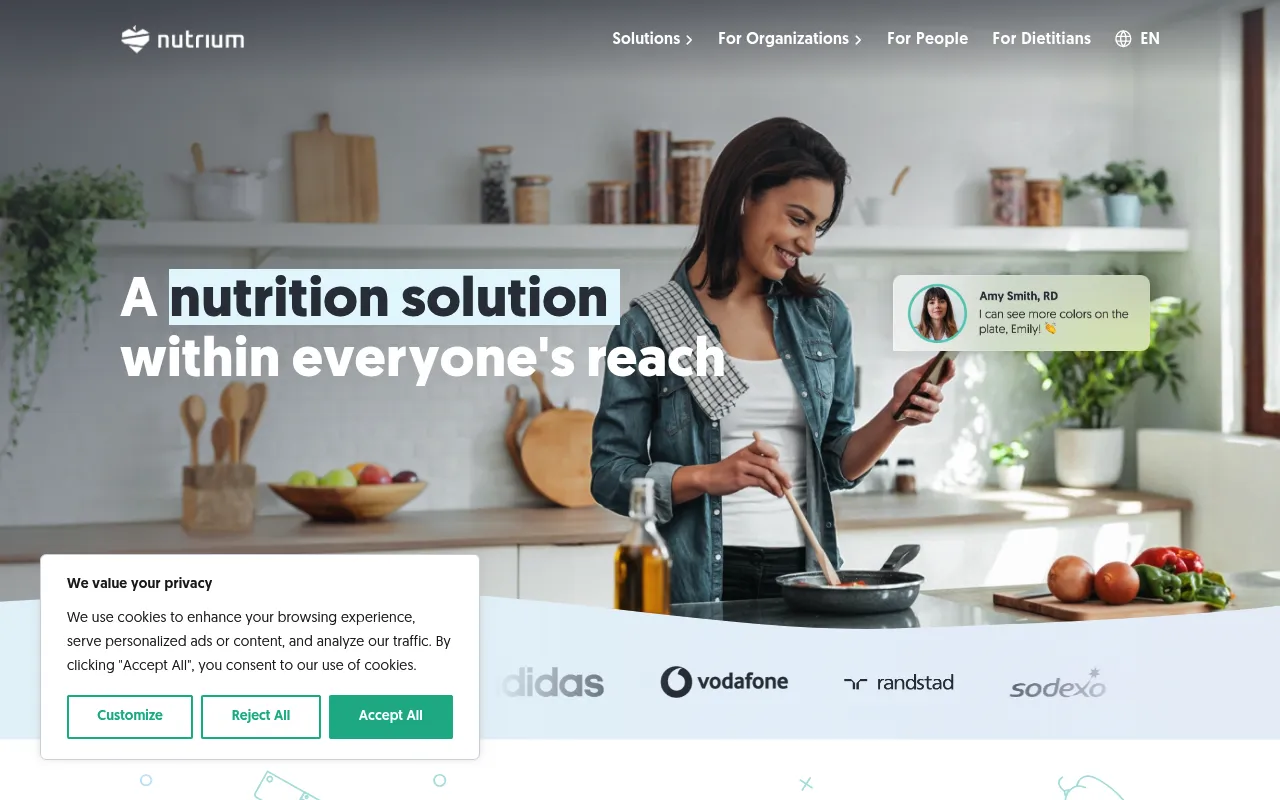
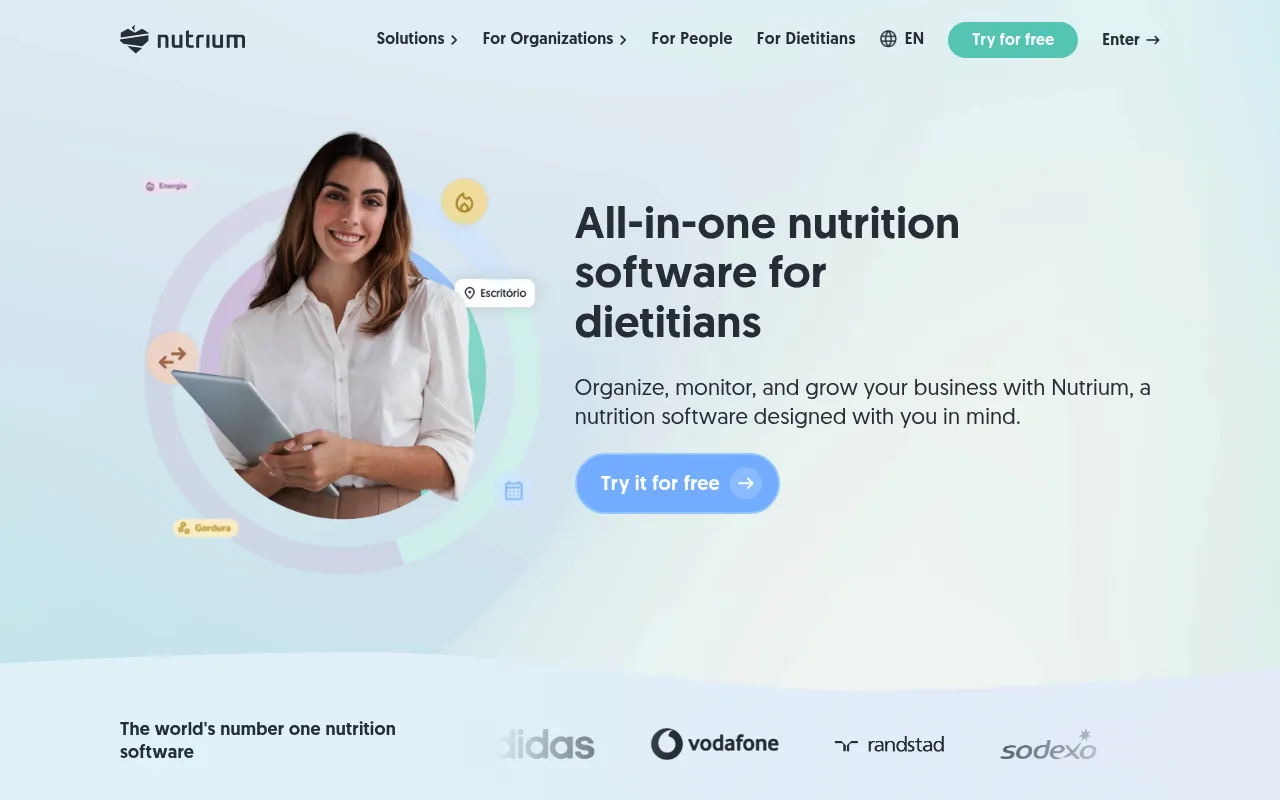
Nutrium combines meal planning with full practice management: appointment scheduling, client records, telehealth, and progress tracking. It serves 120,000+ professionals across 120 countries and supports 20+ interface languages. If you want one platform for everything and you're working clinically, Nutrium is the closest thing to a complete solution. The trade-off: meal planning features are less specialized than tools that focus only on plans.
Pros
- Full practice management plus nutrition in one tool
- Micronutrient tracking (25+ nutrients)
- Client mobile app with food logging
- HIPAA and GDPR compliance available
- 120,000+ users across 120 countries
Cons
- No white-label meal plan exports
- Recipes are user-built, not provided
- Heavier interface, longer learning curve
- Telehealth and HIPAA add cost
Pricing: From $28/mo (annual billing). Add-ons for telehealth and HIPAA.
4. Foodzilla
Best for a custom-branded mobile app
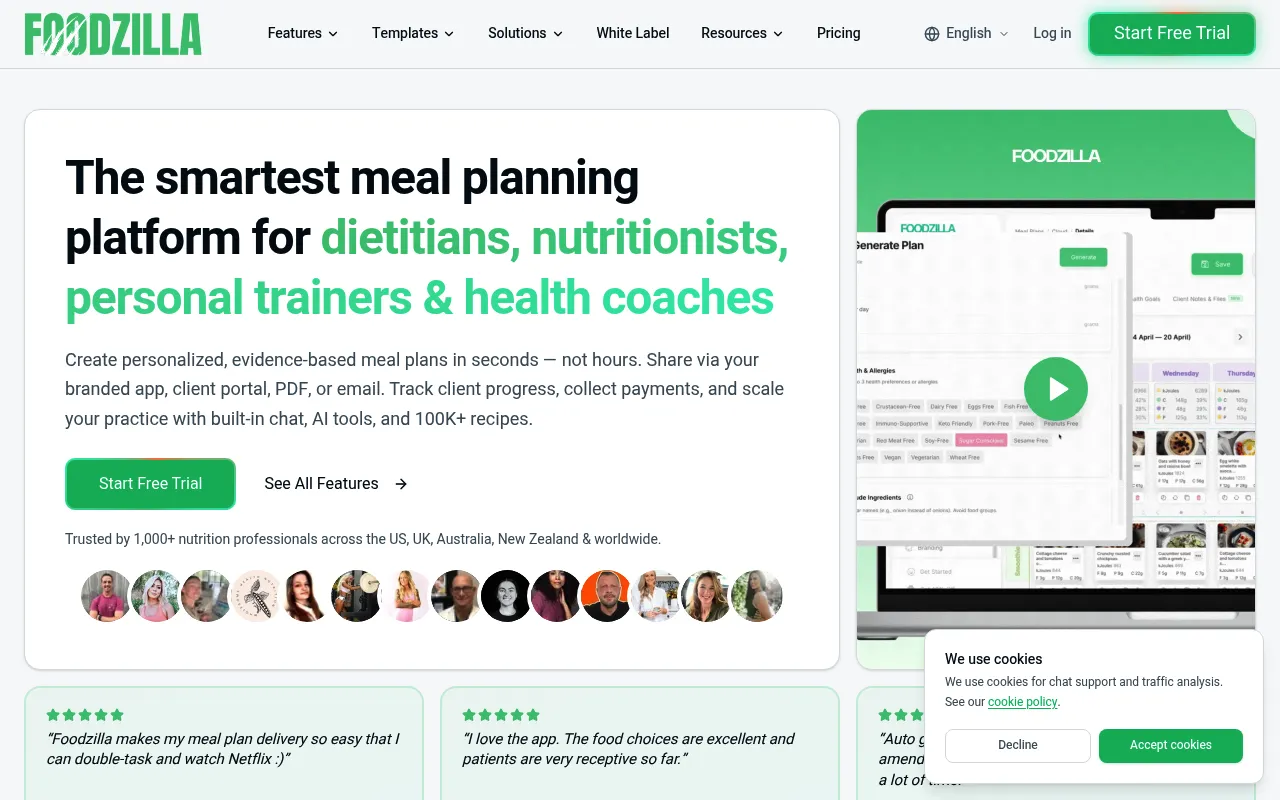
Foodzilla stands out for the Professional plan, which includes a custom-branded mobile app published to the Apple App Store and Google Play under your business name. That's the strongest white-label option in this group at this price. AI food logging from photos, wearable integration (Fitbit, Apple Health), and per-client pricing make it affordable when you're starting small.

Pros
- Custom-branded mobile app on App Store + Google Play
- AI food logging from photos
- Wearable integration (Fitbit, Apple Health)
- Per-client pricing scales with your roster
Cons
- Branded app needs setup fee plus 4-6 weeks build time
- Per-client pricing climbs fast as you scale
- Fewer reviews than the bigger names
- Recipe library smaller than That Clean Life
Pricing: Starter from $17/mo (annual). Professional $35/mo annual or $59/mo monthly. Custom app: setup fee + monthly.
5. Practice Better
Best for full practice management (not meal planning alone)
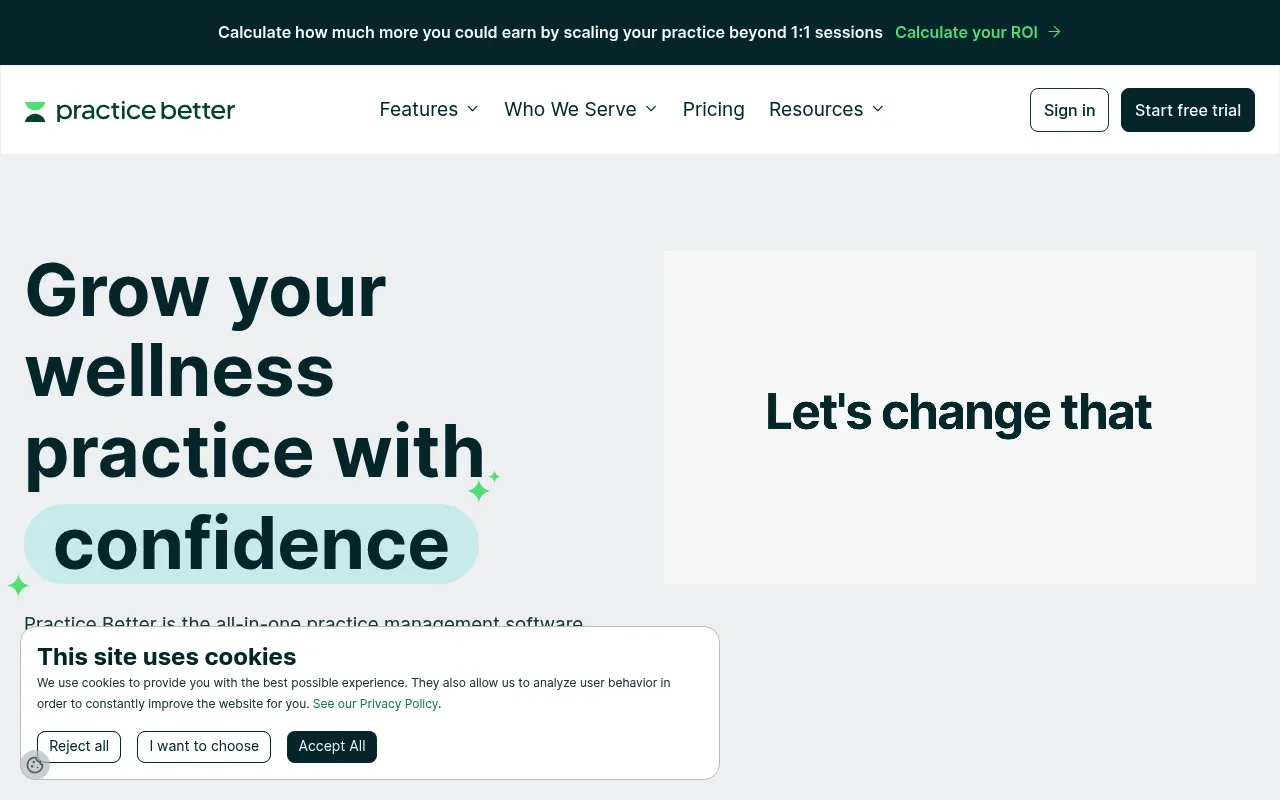
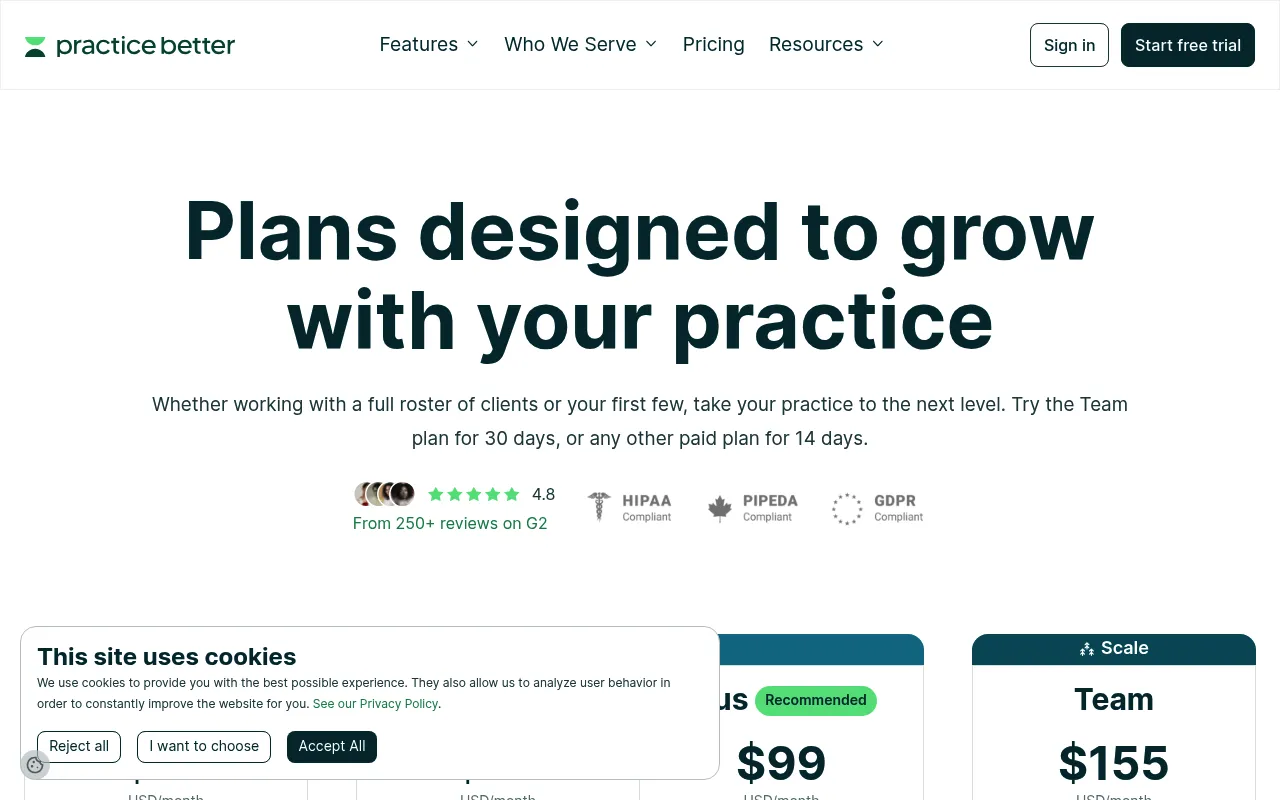
Practice Better is a full EHR (electronic health record) platform with a nutrition module bolted on. If you need scheduling, charting, billing, and telehealth, this is the most complete option. Worth knowing: Practice Better itself recommends integrating That Clean Life for actual meal planning, which means a nutritionist on Professional ($69/mo) plus That Clean Life Plus ($60/mo) is paying about $129/mo across two platforms.
Pros
- Full EHR with scheduling, charting, billing
- HIPAA-compliant by design
- Built-in telehealth and secure messaging
- Sprout free plan for new practitioners
- Strong client portal with forms and documents
Cons
- Meal planning is weak, recommends adding That Clean Life
- No white-label meal plan exports
- Effective cost climbs to ~$129/mo with TCL bolt-on
- Overkill if you only need meal plans
Pricing: Sprout (free), Professional $69/mo, Plus and higher tiers above. Add That Clean Life for ~$30-60/mo if you want real meal planning.
6. NutriAdmin
Best budget option with AI generation
NutriAdmin markets itself on a "60-second" AI meal plan generator built on OpenAI, with 40+ supported diets and 18 cuisine options. It's a CRM-plus-meal-planner combo with 23,900+ users and a 4.7/5 self-reported rating. Solid budget pick if you want AI generation and can live with a smaller, less-validated recipe library than That Clean Life or Promealplan.
Pros
- Cheapest AI meal plan generator on this list
- 40+ supported diets, 18 cuisines
- Built-in CRM for client management
- 14-day free trial, 30-day money-back guarantee
Cons
- AI-generated recipes risk macro hallucinations
- Smaller verified recipe library
- White-label gated to higher tiers
- Less polished interface than top picks
Pricing: From $19/mo (annual billing). 14-day free trial.
Side-by-Side Feature Comparison
Six tools, the features nutritionists ask about most, and the entry-level price for each. Hover or scroll horizontally on mobile.
| Feature | Promealplan | That Clean Life | Nutrium | Foodzilla | Practice Better | NutriAdmin |
|---|---|---|---|---|---|---|
| Entry price | Free | $30/mo | $28/mo | $17/mo | Free (Sprout) | $19/mo |
| White-label | All plans | Plus ($60/mo) | No | Pro ($35/mo) | No | Higher tiers |
| Recipe library | 1,000+ verified | 8,000+ | User-built | 1,000+ | Limited | AI-generated |
| Macro auto-targeting | Yes (2% accuracy) | Manual | Yes | Yes | Basic | Yes (AI) |
| Micronutrients | No | Yes | 25+ | Yes | Yes | Yes |
| Client portal | Yes | Yes | Yes | Yes | Yes | Yes |
| HIPAA | No | No | Yes | No | Yes | No |
| Scheduling / EHR | No | No | Yes | Basic | Full EHR | CRM only |
| Client languages | EN, FR, ES | EN | 20+ | EN | EN | EN |
| Free plan (permanent) | Yes | No | No | No | Yes (Sprout) | No |
How to read this table. If white-label branding from day one matters, Promealplan is the only tool that includes it on the free plan. If you need micronutrient tracking and HIPAA, Nutrium and Practice Better are the realistic options. If you want the largest recipe library, That Clean Life. If a branded mobile app is the goal, Foodzilla Professional. None of these tools is "the best" for every nutritionist, which is why we split the recommendation by practice type up top.
How to Pick: A Decision Matrix
Read the question, follow the answer, pick the tool. This is the same logic we use when nutritionists ask us "should I switch from X?".
Do you bill insurance or work with a healthcare org?
If yes, you need HIPAA. Nutrium or Practice Better. Skip the rest.
Is your client deliverable a meal plan with branding?
If yes, white-label matters. Promealplan (every tier), That Clean Life Plus, or Foodzilla Professional.
Are you starting out with under 10 clients?
Promealplan Free or Practice Better Sprout. Build a real plan for a real client before you spend a cent.
Do you serve clients in French or Spanish?
Promealplan ships plans in English, French, and Spanish. Nutrium has 20+ interface languages but you build recipes yourself.
Do you treat IBS, diabetes, PCOS, or other conditions?
That Clean Life has condition-specific templates ready to use. Pair with Practice Better if you also need charting.
Is a custom mobile app on the App Store the goal?
Foodzilla Professional. Budget for the setup fee plus 4-6 weeks build time.
How Nutritionists Use Promealplan in Practice
Here's the typical workflow from intake to plan delivery. The whole process takes under 5 minutes once you've used the tool a few times. We're putting this here because if you've read this far, you're considering Promealplan, and you should see what the day-to-day actually looks like.
Set up the client profile
Enter your client's weight, goals, dietary restrictions, and allergens. Takes about a minute. The profile feeds every plan you build for that client going forward.
Set macro targets
Define the calorie target and macro split (protein, carbs, fat). Use your own calculations or let the tool suggest targets based on the profile.
Generate the plan
The algorithm picks from 1,000+ verified recipes, adjusts portions to hit your macro targets within 2% per day, and builds a complete weekly plan with a grocery list. This is where the time savings show up.
Customize and swap recipes
Review the generated plan. Swap any recipe for an alternative that fits the same nutritional profile. Macros recalculate automatically. Add notes or instructions for your client.
Deliver via portal or PDF
Send your client a link to their branded portal where they can browse recipes, check the grocery list, and view the plan from any device. Or export a white-label PDF with your logo and colors. Both are included on every tier, including Free.
Client sees your brand, not ours
Every touchpoint carries your practice name and branding. Your client associates the quality of the plan with your expertise. That's how you earn referrals instead of teaching clients to remember the software.
Common Mistakes Nutritionists Make Choosing Software
Three mistakes show up over and over when nutritionists pick a tool, then switch six months later. None of them are about the software. They're about the assumptions going in.
Picking the cheapest tier and discovering branding is gated
That Clean Life Starter ($30/mo) has no white-label. To get your logo on the plan, you need Plus ($60/mo). Foodzilla Starter ($17/mo) sits below the white-label tier as well. Always check which tier includes branding before you commit. The tier you actually need is often $30-60/mo more than the headline price.
Assuming Practice Better does meal planning
It doesn't, not really. The product itself recommends integrating That Clean Life. If meal plans are the core deliverable for your clients, you're paying for two tools, not one. Effective monthly cost lands around $129. Worth knowing before the second invoice.
Choosing micronutrients you don't actually use
Tools like Nutrium and Cronometer Pro track 25+ nutrients. That's necessary for clinical nutrition (renal disease, anemia, pregnancy). It's overkill for fitness, weight management, or general wellness, where macros and total calories drive 95% of outcomes. Don't pay for clinical-grade tracking if your practice is macro-driven.
Related Reading
Frequently Asked Questions
What's the difference between nutritionist and dietitian software?
Do I need HIPAA-compliant software?
Can I white-label meal plans with my brand?
How many recipes do I really need?
Does Practice Better do meal planning natively?
Is there free meal planning software for nutritionists?
Pick the Right Tool for Your Practice
The best meal planning software for you depends on what your practice actually looks like. If you need an all-in-one platform with scheduling and charting and you're working clinically, Nutrium or Practice Better cover the most ground. If you want the largest recipe library and condition-specific templates, That Clean Life. If you want a custom-branded mobile app, Foodzilla Professional. If you want fast macro-focused plans with white-label branding from day one, including on the free plan, that's where Promealplan fits.
Whichever tool you pick, the goal is the same. Spend less time on spreadsheets and more time with clients. Every hour you reclaim from manual plan creation is an hour you can spend on consultations, follow-ups, or growing your practice. Or, if you're being honest, taking an actual lunch break.
Ready to save 30+ minutes per meal plan?
1,000+ dietitian-validated recipes. White-label on every tier, including Free. No credit card required to start.
Create 3 free meal plans →