NutriAdmin vs That Clean Life: Which Fits Your Dietitian Practice?
You're weighing NutriAdmin against That Clean Life because both promise to make your dietitian practice easier. They're playing different games. NutriAdmin bundles CRM, scheduling, telehealth, billing, and meal planning into a single all-in-one hub. That Clean Life skips practice management entirely and goes deep on meal planning, with a recipe library built by dietitians and a branded client portal. Here's an honest side-by-side from a private-practice dietitian's lens, with the macro precision gap that neither one closes.

Quick Verdict
Pick NutriAdmin if you want one platform to run the whole practice. CRM, scheduling, telehealth, secure messaging, billing, and meal planning sit inside the same dashboard. Plans start at $24.99/month on Starter, the recipe library covers 6,000+ entries with multi-language support, and the auto-planner builds a full day in around 60 seconds. International coverage spans 100+ countries, so it's natural for English, Spanish, French, and other language markets.
Pick That Clean Life if meal planning is the sharpest part of your service and you already have an EHR or practice management tool. The library carries 8,000+ recipes built by dietitians, the visual plan editor gives you control on assembly, the client portal carries your brand, and automatic grocery lists drop straight into the client's app. Solo runs around $45/month, Business around $99/month. The platform plays nicely with Practice Better for the clinical EHR layer.
Neither one enforces macro precision to the gram. NutriAdmin's 60-second planner hits calorie totals and broad macro splits but doesn't lock per-meal protein, carb, and fat targets. That Clean Life leans on whole-food balance and dietitian-curated recipes over strict gram calibration. If macro precision is the core of your premium service, you'll need a dedicated tool alongside either platform. More on that below.
NutriAdmin at a Glance

NutriAdmin positions as an all-in-one practice management hub for dietitians, nutritionists, and clinicians who want one tool to run the entire practice. The product bundles client CRM (intake forms, assessments, notes), calendar and scheduling, secure telehealth video, messaging, billing and invoicing, and a meal-planning module that auto-generates day or week plans in around 60 seconds. The promise: stop juggling six separate tools and consolidate into one dashboard.
On pricing, NutriAdmin opens at $24.99/month on the Starter plan, which keeps it affordable for a solo practitioner getting started. Higher tiers (Standard, Professional, Premium) include more active clients, multi-practitioner teams, advanced reporting, branded portal customization, and full HIPAA support. The platform serves practitioners in 100+ countries and offers the interface in multiple languages, which makes it natural for English-speaking, Spanish-speaking, and French-speaking practices alike.
On recipes, NutriAdmin advertises 6,000+ entries, spanning international cuisines and dietary preferences. Quality is uneven across the catalog. Some recipes are dietitian-validated and pristine, others read more like community contributions. The auto-planner pulls from this library to assemble plans hitting calorie totals and broad macro splits in seconds. For a deep dive on the practice management side, read our complete NutriAdmin review.
That Clean Life at a Glance
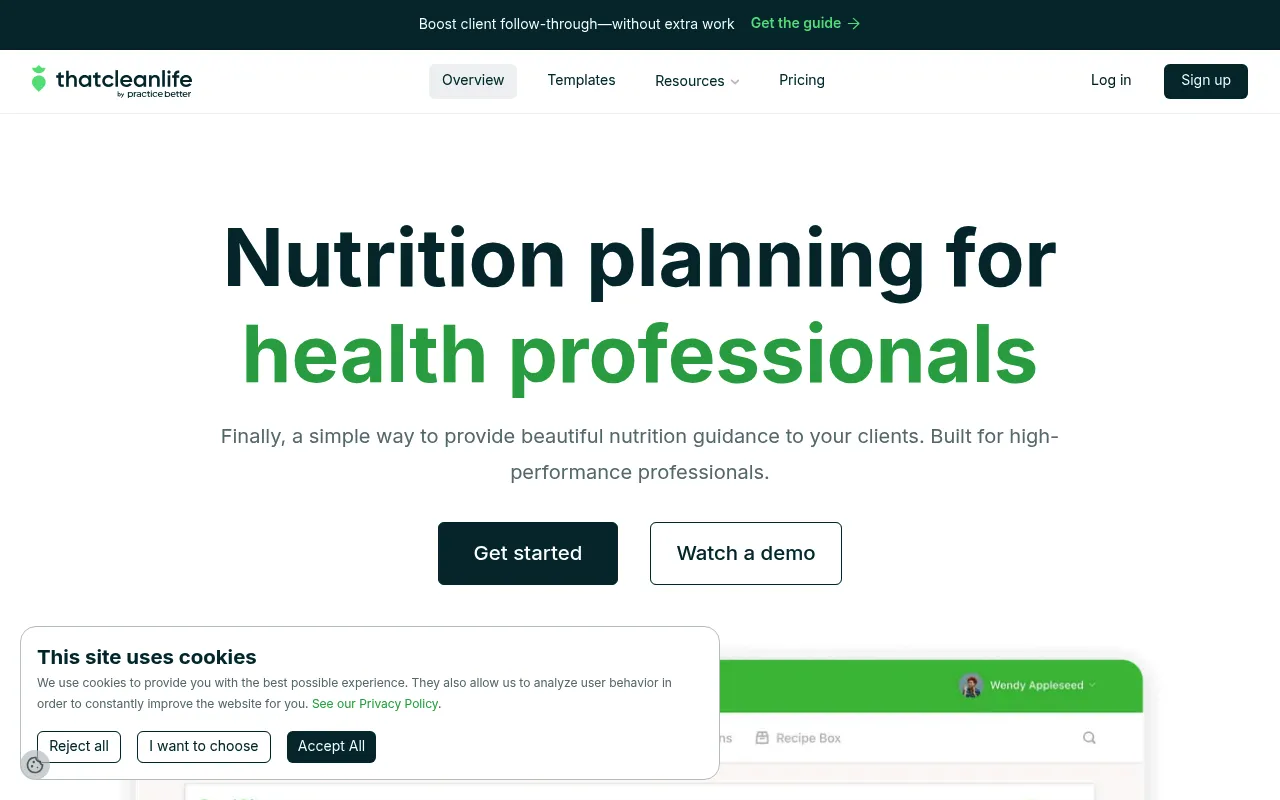
That Clean Life takes the opposite approach: skip practice management entirely and go deep on meal planning. Canadian origin, founded in 2014, the product targets dietitians and nutrition professionals who want the sharpest meal-planning experience available, with whole-food recipes built and curated by dietitians. The platform doesn't try to be a CRM or a telehealth tool. It does one thing and tries to do it better than anyone else.
The recipe library carries 8,000+ entries, all built or vetted by dietitians, with whole-food ingredients, clear allergen tagging, and nutrition profiles that hold up under clinical review. The visual plan editor lets you drag and drop meals into a weekly grid, swap ingredients, and adjust portions. Each plan ships with an automatic grocery list, organized by category, that the client receives in their branded portal. The portal carries your logo, your colors, and your domain.
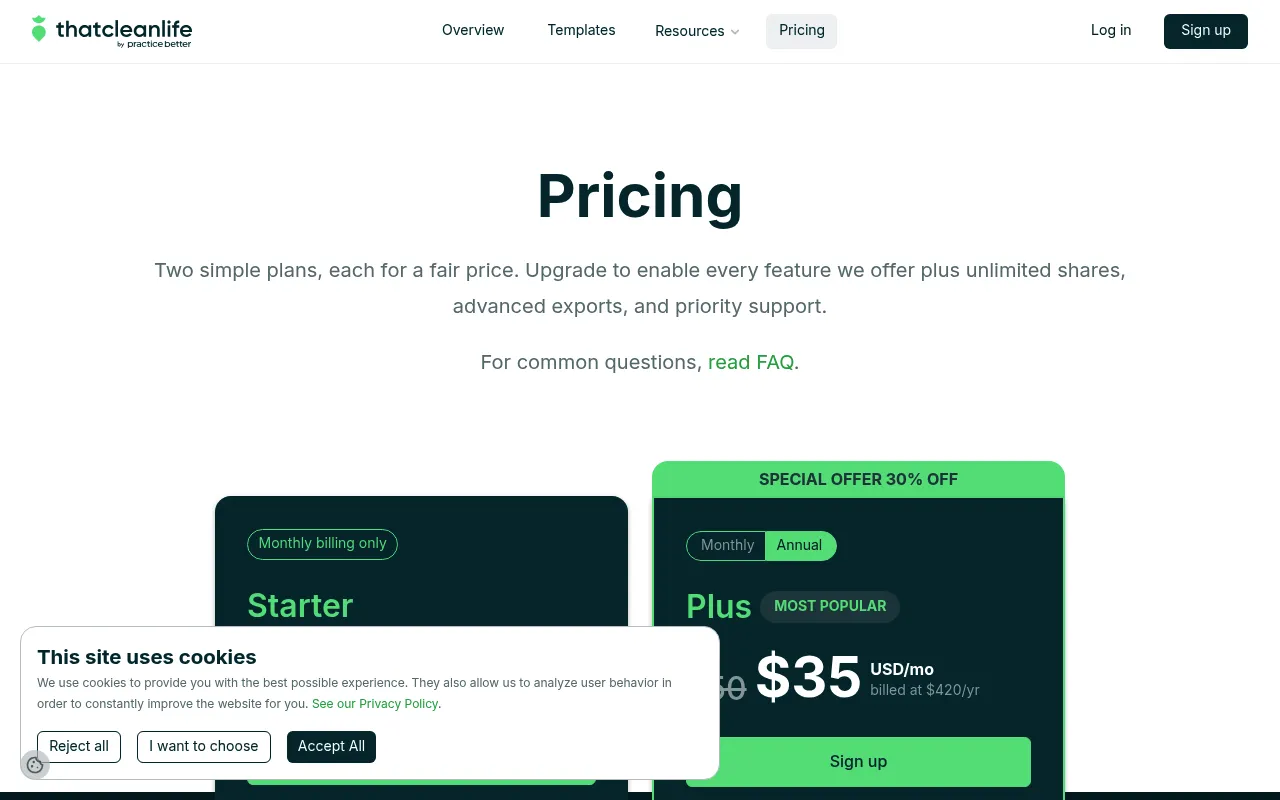
On pricing, Solo runs around $45/month and Business around $99/month in 2026 USD. That Clean Life integrates with Practice Better for the clinical EHR layer, so practitioners who already use Practice Better can keep their CRM and notes there while delivering plans through That Clean Life. For a detailed walk-through, read our complete That Clean Life review.
Pricing Side-by-Side (2026)
The pricing models tell you what each platform thinks it's selling. NutriAdmin spreads cost across the whole practice stack, so the entry ticket stays accessible. That Clean Life prices for meal planning depth, so the ticket runs higher but you get a sharper specialist tool. Here's how they line up.

| NutriAdmin | That Clean Life | |
|---|---|---|
| Free trial | Free trial available | Free trial available |
| Entry plan | Starter: $24.99/mo | Solo: ~$45/mo |
| Mid-tier | Standard / Professional | Business: ~$99/mo |
| Top tier | Premium (team features) | Business (multi-practitioner) |
| Recipe library | 6,000+ recipes | 8,000+ dietitian-built recipes |
| Plan generation | 60-second auto-planner | Visual plan editor + templates |
| Client portal | Branded portal included | Branded client portal + grocery lists |
| CRM / scheduling / telehealth | Native, bundled | Integrates with Practice Better |
| Languages | Multi-language, 100+ countries | English primary |
| Primary market | International, multi-language | North America (Canada, US) |
| Key strength | All-in-one practice hub | Meal planning depth + curation |
For a private-practice dietitian getting started, NutriAdmin's $24.99 entry ticket is hard to beat if you don't already have a CRM or scheduling tool. That Clean Life costs almost twice as much at the Solo tier, but the depth on meal planning shows up immediately: dietitian curation, automatic grocery lists, and a polished client portal. Over time, the right pick depends less on price and more on whether you want a single tool or the sharpest specialist on top of an existing EHR.
Recipe Library: 6,000 NutriAdmin vs 8,000 That Clean Life
On raw numbers, That Clean Life carries more recipes (8,000+ vs 6,000+). But the quality differential matters more than the count for most dietitians' practices. That Clean Life's catalog is curated and built by dietitians, with whole-food ingredients, clear macro and micronutrient profiles, and allergen tags that hold up under clinical review. The recipes look like food a dietitian would actually recommend, not generic web-scraped content.
NutriAdmin's 6,000+ entries cover a wider international range, which suits its 100+ country footprint. The variety is real, but quality is uneven. Some recipes are dietitian-validated and clean. Others feel more like community contributions, with looser ingredient lists or vague portion guidance. For a practice that serves diverse cultural cuisines (Mediterranean, Middle Eastern, Latin American, Asian), the breadth helps. For a practice that prioritizes rigorous nutrition curation, the unevenness shows.
Allergen filtering follows the same pattern. That Clean Life ships clean filters for gluten-free, dairy-free, nut-free, soy-free, vegan, vegetarian, paleo, and several others, with reliable tagging across the library. NutriAdmin's filters cover similar categories but tagging consistency varies, so you'll want to spot-check recipes before sending plans to clients with strict food sensitivities.
Plan Generation: 60-Second Auto-Planner vs Visual Templates
NutriAdmin's headline meal-planning feature is the 60-second auto-planner: enter the client's calorie target, macro split, allergens, and dietary preferences, hit generate, and the platform assembles a day or week plan from its 6,000+ recipe library. The speed is real, and for a solo dietitian running 40 to 80 clients, the time savings stack up fast. The trade-off: the auto-planner optimizes for calorie totals and a broad macro split, not for per-meal gram targets, so review the output before sending.
That Clean Life takes a different bet. Instead of an auto-planner, the platform gives you a visual plan editor with weekly meal grids, drag-and-drop recipe assembly, ingredient swaps, and portion adjustments. The workflow is more hands-on. You'll spend more time building each plan, but you'll have more control over every meal that lands in the client's portal. The platform also ships pre-built meal plan templates (low-FODMAP, anti-inflammatory, plant-based, Mediterranean, and others) that dietitians have already validated, so you can clone and customize instead of starting from scratch.
Which approach wins depends on your method. If you build plans in volume and trust the platform to handle the macros, NutriAdmin's 60-second auto-planner is faster. If you want to curate each plan with intention and use dietitian-validated templates as starting points, That Clean Life's visual editor lines up better with how a clinical-leaning dietitian actually works.
Client Management: NutriAdmin Portal vs Practice Better Integration
NutriAdmin handles client management natively. The CRM tracks intake forms, assessments, session notes, progress photos, body measurements, and adherence data inside the same dashboard where you build meal plans. Scheduling, telehealth video, secure messaging, and billing all sit in the same product. For a solo practitioner who doesn't already use a separate EHR, that consolidation is the core appeal.
That Clean Life deliberately doesn't try to be a CRM. Instead, it integrates with Practice Better, the dominant clinical EHR for North American dietitians, so practitioners can keep their charting, intake forms, and clinical notes in Practice Better while delivering plans through That Clean Life. The integration means client data flows between the two tools without manual re-entry. The downside: you're paying for two subscriptions instead of one, which adds up if your practice is small.
For a private-practice dietitian who's already invested in Practice Better, the That Clean Life integration is a clean fit. For a solo dietitian or coach starting fresh without an EHR, NutriAdmin's consolidated approach often wins on simplicity and total monthly spend.
White-Label PDFs and Client-Facing Branding
Both platforms let you brand the meal plans and client experience, but depth differs. NutriAdmin's branded client portal carries your logo, your colors, and your practice name across the dashboard the client logs into. Exported plan PDFs include your branding, and you can customize headers, footers, and intro pages. The white-label is solid but stays within the constraints of the all-in-one platform's templates.
That Clean Life goes deeper on the client-facing branding. The portal feels like your tool, not a re-skinned NutriAdmin or generic app. PDFs ship with full white-label on every page, grocery lists carry your brand, and the visual design has the kind of polish you'd expect from a meal-planning specialist. For a dietitian whose business depends on premium brand presence (high-ticket clients, corporate wellness contracts, online programs), the polish difference shows up in client perception.
Which Dietitian Wins With Which Tool
The right pick depends on your starting stack, your client volume, and how much you value depth over breadth. Here are the three profiles where each platform clearly wins.
Solo dietitian without an existing EHR
NutriAdmin wins. The $24.99 entry ticket gets you CRM, scheduling, telehealth, billing, and meal planning under one roof. For a practitioner starting fresh or migrating from spreadsheets and Calendly, the consolidation simplifies day-to-day operations and cuts total tool spend significantly. The 60-second auto-planner also handles plan volume well for a fast-growing practice.
Established practice already using Practice Better
That Clean Life wins. If you've already invested in Practice Better for clinical charting, the That Clean Life integration adds sharper meal planning without forcing a migration. The 8,000+ dietitian-built recipes, visual plan editor, and polished client portal lift the perceived quality of every plan you deliver, which justifies premium pricing on your service.
International or multi-language practice
NutriAdmin wins. The platform's multi-language interface and 100+ country footprint make it natural for practices serving English, Spanish, French, German, or Portuguese-speaking clients. That Clean Life is English-primary and Canadian-anchored, which makes it a tighter fit in North America than in continental Europe, Latin America, or Asia.
The Shared Limit: No Macro-Precise Plans to the Gram
NutriAdmin and That Clean Life solve different problems but share the same blind spot on macro precision. Neither platform enforces per-client protein, carb, and fat targets to the gram across every meal of the day. NutriAdmin's auto-planner hits calorie totals and a broad macro split (40/30/30, for instance) in 60 seconds, which works for most general-nutrition clients but doesn't lock in gram-level accuracy. That Clean Life's visual editor and dietitian-built recipes deliver whole-food balance, but the planning engine prioritizes nutrition fundamentals over strict macro calibration.
What each platform actually offers for meal planning
NutriAdmin
- - 60-second auto-planner from a calorie and macro brief
- - 6,000+ recipes spanning international cuisines
- - Calorie totals and broad macro splits, not per-meal grams
- - Allergen filters with variable tagging consistency
- - Review recommended before sending plans to clients
That Clean Life
- - 8,000+ dietitian-built whole-food recipes
- - Visual plan editor with drag-and-drop assembly
- - Whole-food balance focus, not strict gram targets
- - Clean allergen filters with consistent tagging
- - Polished white-label client portal and grocery lists
If your clients accept plans calibrated to calorie totals and broad macro splits, either platform handles the job. If you work with competitive athletes, body recomposition clients, contest-prep profiles, or any client paying premium for letter-of-the-law macro precision, you'll end up adjusting plans in a spreadsheet, then re-uploading them. That friction costs hours every week and weakens the premium positioning your service depends on.
Close the macro precision gap. Promealplan generates macro-precise meal plans your That Clean Life or NutriAdmin workflow can't deliver alone. White-label, 1,000+ dietitian-validated recipes, 3 languages. Free trial, 3 plans, no credit card needed.
Create 3 free meal plans →Promealplan vs NutriAdmin vs That Clean Life
Promealplan isn't a practice management hub or a whole-food meal planning specialist. It's a tool built specifically for macro-precise plan production, designed to sit alongside NutriAdmin or That Clean Life. You keep your current platform for what it does best, and Promealplan delivers the gram-precise plans your premium clients pay for. Here's how the three compare on the criteria that matter most for a private-practice dietitian.
| NutriAdmin | That Clean Life | Promealplan | |
|---|---|---|---|
| Per-client macros to the gram | No, broad splits | No, whole-food balance | Yes, native |
| Recipe library | 6,000+ international | 8,000+ dietitian-built | 1,000+ dietitian-validated |
| Allergy / dietary filters | Variable tagging | Clean, consistent | 200+ filters |
| White-label PDF | Yes, templated | Yes, polished | Yes, full white-label |
| Languages | Multi-language | English primary | EN / FR / ES |
| Practice management | Native, all-in-one | Practice Better integration | Out of scope, sits alongside |
| Entry price | $24.99/mo | ~$45/mo | Free trial, no card |
The logic stays simple. Each tool stays sharp at its job. Your clients log into NutriAdmin for their practice interactions or receive their whole-food plans through That Clean Life, and receive their premium gram-precise plans from Promealplan, with consistent brand presence across the entire experience. For head-to-head breakdowns, see our Promealplan vs NutriAdmin and Promealplan vs That Clean Life comparisons.
Three Profiles, Three Picks
The right tool depends on your stack, your client mix, and the level of macro precision your service promises. Here are three typical private-practice dietitian profiles and the matching recommendation.
The solo dietitian consolidating into one platform
You're running 30 to 80 clients, you don't have an EHR, and you're tired of juggling Calendly, Zoom, Square for billing, and a separate meal planner. You want everything in one dashboard at an accessible monthly price.
Pick NutriAdmin. The $24.99 entry ticket consolidates CRM, scheduling, telehealth, billing, and meal planning. The 60-second auto-planner handles plan volume well, and the multi-language interface plays well with international clients. For most general-nutrition private practices, this is the cleanest single-tool consolidation available.
The clinical-leaning practice already on Practice Better
You've invested in Practice Better for clinical charting, intake forms, and SOAP notes. You want the sharpest meal-planning specialist available to layer on top, with dietitian-built recipes and a polished client portal that lifts your perceived quality.
Pick That Clean Life. The 8,000+ dietitian-built recipes, visual plan editor, and integrated Practice Better workflow let you ship premium plans without disrupting your EHR. The branded client portal and automatic grocery lists make the client experience feel like a flagship service, which supports higher pricing.
The practice serving athletes and body recomposition clients
You work with competitive athletes in prep, body recomposition profiles, or contest-prep clients paying premium for plans that hit macros to the gram. Every plan must lock per-meal protein, carb, and fat targets across the entire week.
Neither one alone is enough. Add Promealplan alongside NutriAdmin or That Clean Life. Keep the practice management or whole-food planning where it already works, and use Promealplan to deliver the macro-precise plans your premium clients pay for. Three languages, white-label, 200+ allergy and dietary filters, automatic grocery lists.
Bottom Line
NutriAdmin wins on practice consolidation, accessible entry pricing, multi-language coverage, and 60-second plan generation. That Clean Life wins on recipe quality, dietitian curation, visual plan editing depth, and the polish of the client-facing experience. The right pick depends less on the tool and more on whether you want a single all-in-one hub or the sharpest meal-planning specialist on top of an existing EHR.
If you want to consolidate your stack and don't already have an EHR, NutriAdmin is the rational choice. If you're already invested in Practice Better and want the sharpest meal-planning specialist, That Clean Life is the cleaner fit. Verify the live pricing pages before committing, since grids shift through the year.
Either way, macro-precise plan production stays the shared weak spot. Promealplan complements either platform without replacing it, so your premium clients get gram-precise plans under your brand while you keep the rest of your stack intact. To dig further, see our Nutrium vs NutriAdmin, Foodzilla vs That Clean Life, or our broader roundup of dietitian meal planning software.
Frequently Asked Questions
Is NutriAdmin or That Clean Life better for a dietitian's private practice?
It depends on what you need to consolidate. NutriAdmin is an all-in-one practice management hub: CRM, scheduling, telehealth, billing, and meal planning bundled into one product. Plans start at $24.99/month on Starter, with a library of 6,000+ recipes. That Clean Life is a meal-planning specialist with 8,000+ recipes built by dietitians, a branded client portal, automatic grocery lists, and a visual plan editor. Solo runs around $45/month, Business around $99/month. Pick NutriAdmin if you want a single tool to run the whole practice. Pick That Clean Life if you already use Practice Better or a separate EHR and want the sharpest meal-planning experience on top.
Do NutriAdmin or That Clean Life generate macro-precise meal plans to the gram?
Not really, neither does it cleanly. NutriAdmin's auto-planner can hit calorie totals and a broad macro split (40/30/30, for example) in around 60 seconds, but it doesn't enforce per-client protein, carb, and fat targets to the gram across every meal of the day. That Clean Life leans on its visual plan editor and 8,000+ recipes built by dietitians, with strong nutrition fundamentals, but the planning engine prioritizes whole-food balance over strict macro calibration. If your clients pay premium for plans that hit macros to the letter, you'll need a dedicated tool like Promealplan alongside either platform.
Which platform has better recipes for clinical-leaning dietitians?
That Clean Life pulls ahead on recipe quality. The library of 8,000+ recipes is built and curated by dietitians, with whole-food ingredients, clear allergen tagging, and nutrition profiles that hold up under scrutiny. NutriAdmin's 6,000+ recipes cover a wider international range (the platform serves practitioners across 100+ countries) but quality is more uneven, with some entries that read more like community contributions than dietitian-validated formulations. For private-practice dietitians serving clients with complex preferences or food sensitivities, That Clean Life's curation tends to feel sharper out of the box.
How much do NutriAdmin and That Clean Life cost per month in 2026?
NutriAdmin starts at $24.99/month on the Starter plan, with higher tiers (Standard, Professional, Premium) unlocking more clients, advanced scheduling, telehealth, and team features. That Clean Life runs around $45/month for the Solo plan and around $99/month for the Business plan in USD 2026 pricing. Both offer free trials. NutriAdmin sits cheaper at the entry door because it spreads cost across the entire practice management stack. That Clean Life costs more per month, but you're paying for a sharper, deeper meal-planning experience. Verify the live pricing pages before committing since both grids shift through the year.
Can I use Promealplan alongside NutriAdmin or That Clean Life?
Yes, and many private-practice dietitians do exactly that. NutriAdmin handles your full practice operations (CRM, scheduling, telehealth, billing). That Clean Life handles whole-food meal planning with its branded client portal. Promealplan handles macro-precise plan production: per-client protein, carb, and fat targets to the gram, 1,000+ dietitian-validated recipes, 200+ allergy and dietary filters, full white-label PDFs and client portal, automatic grocery lists, and three languages (English, French, Spanish). You keep your current platform for what it does best, and Promealplan delivers the premium macro-precise plans your athletes, body recomposition clients, and high-ticket profiles pay for.
Platform picked. Now ship macro-precise plans.
Promealplan generates gram-accurate meal plans that pair with NutriAdmin or That Clean Life. White-label, 1,000+ dietitian-validated recipes, 3 languages. Free trial, no credit card needed.
Create 3 free meal plansRelated Reading for Dietitians
NutriAdmin Review 2026: All-in-One Practice Hub for Dietitians
Detailed review of NutriAdmin for CRM, scheduling, telehealth, and meal planning.
That Clean Life Review 2026: Meal Planning Specialist for Dietitians
Detailed review of That Clean Life's recipe library, visual editor, and client portal.
Promealplan vs NutriAdmin: Macro Precision vs Practice Hub
Head-to-head between Promealplan's macro precision and NutriAdmin's all-in-one coverage.
Promealplan vs That Clean Life: Macro Precision vs Whole-Food Curation
Head-to-head between Promealplan's gram-precise plans and That Clean Life's dietitian-built library.
Nutrium vs NutriAdmin: Comparison for Dietitians
Honest comparison between Nutrium and NutriAdmin for nutrition practices.
Foodzilla vs That Clean Life: Comparison for Nutritionists
Comparison between AI generation and dietitian-built meal planning.
Dietitian Meal Planning Software: Full 2026 Roundup
The complete guide to the meal-planning software market for private-practice dietitians.