Foodzilla vs Healthie: Which Platform Fits Your Dietitian Practice?
A private-practice dietitian who bills insurance and a coach who ships ten plans a week aren't shopping for the same tool. That's the gap between Healthie and Foodzilla in one line. Healthie is a HIPAA-compliant electronic health record built for the North American clinical market, with insurance billing baked in and a meal planning module that stays secondary. Foodzilla is an AI-first meal planning platform with a branded client app. Here's an honest side-by-side from a practicing dietitian's lens, with the macro precision gap both platforms quietly leave open.

Quick Verdict
Pick Healthie if you practice in the US or Canada and bill insurance. Native HIPAA compliance, signed BAA contracts at no extra cost, a structured electronic health record, and encrypted telehealth make Healthie the reference for a North American clinical practice. The entry ticket sits around $49/month for 1 user, with higher tiers adding insurance billing through Office Ally, advanced intake forms, and team management.
Pick Foodzilla if fast meal plan production is your priority and your clientele accepts generic plans. AI-assisted generation, a branded client app on higher tiers, and an entry ticket around $29/month make it an interesting option for a solo coach or dietitian who wants to industrialize plan production. One honesty note: Foodzilla carries roughly 4.2 stars on Capterra across only about 27 reviews, so the feedback base stays thin.
Neither one nails macro precision to the gram. Healthie keeps the focus on the clinical record with a basic nutrition module. Foodzilla bets on AI, but AI can hallucinate nutritional numbers at scale, and precision is never guaranteed meal by meal. If macro precision is the core of your premium service, you'll need a dedicated tool either way. More on that below.
Foodzilla at a Glance
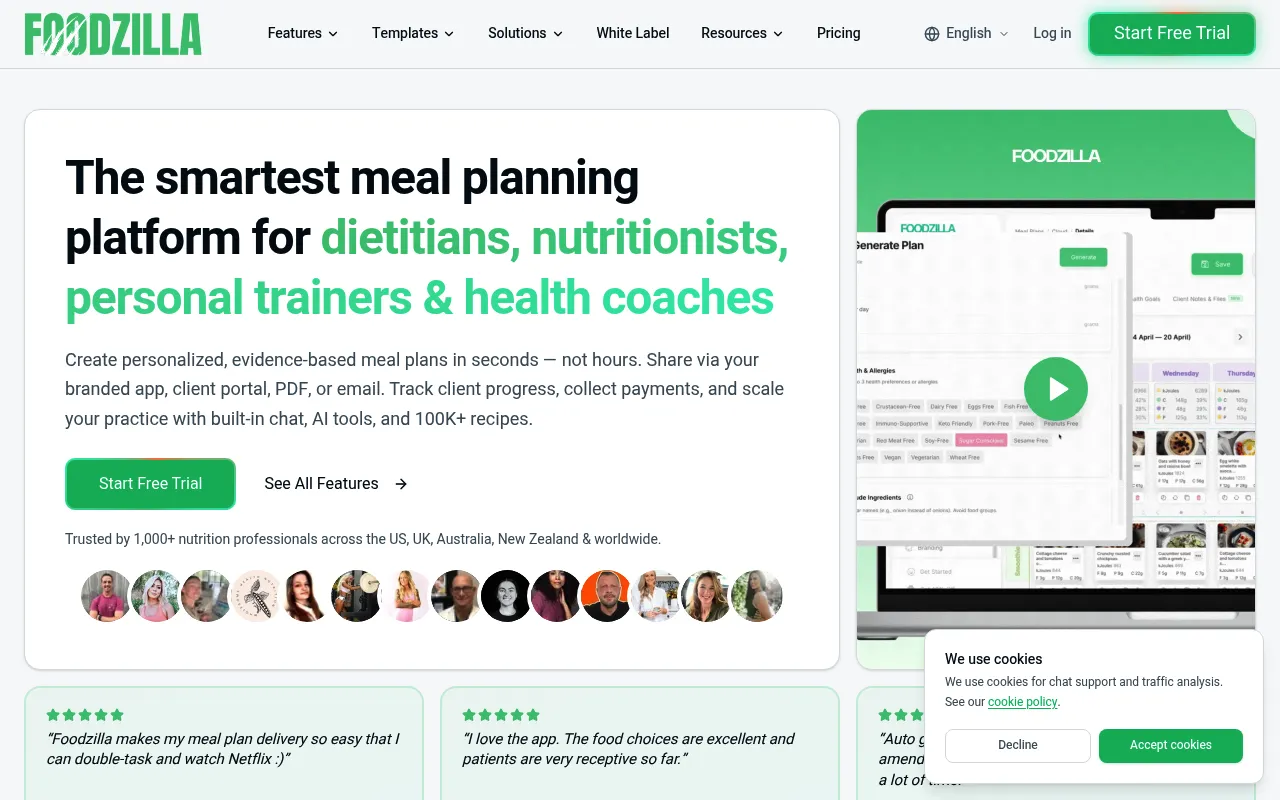
Foodzilla positions itself as an AI-powered nutrition platform for dietitians, nutritionists, and coaches who want to automate plan production. The product highlights a generation engine that assembles a plan from a brief in a handful of clicks, a branded client app, and AI-generated recipes. The core promise: save time on plan creation so you can reinvest it in consultations and client follow-up.
On pricing, Foodzilla starts around $29/month on the entry plan, climbing toward $59. The pricing structure caps the number of clients per tier: the more clients you manage, the higher you move. The branded client app and certain advanced features sit on higher tiers. A free trial lets you test the interface and AI generation before committing.
On reviews, Foodzilla carries a Capterra rating around 4.2 stars across roughly 27 reviews, and ticks about 37 of 41 listed features. Positive notes call out generation speed and ease of onboarding, with recurring remarks about macro precision and the quality of AI suggestions needing a systematic review. For a deep dive, read our complete Foodzilla review.
Healthie at a Glance
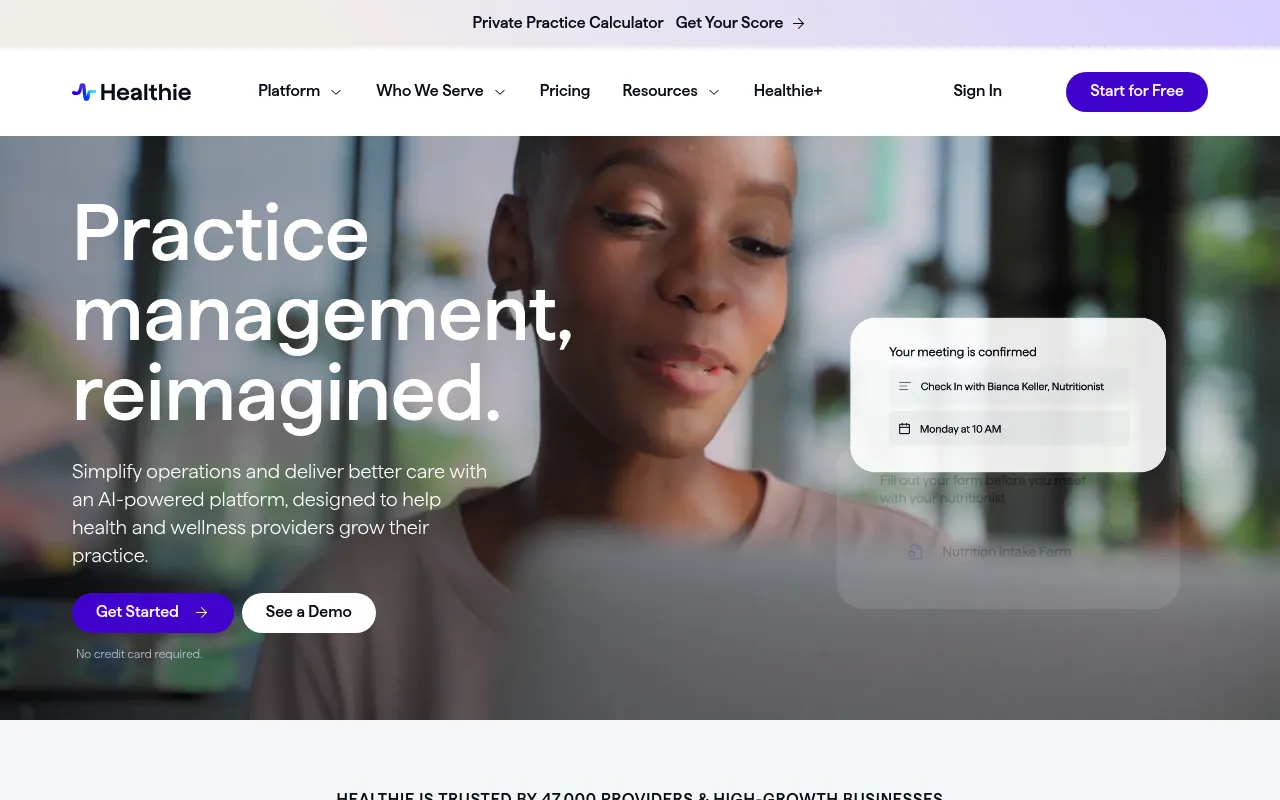
Healthie plays a different game: the reference electronic health record for North American nutrition and wellness practices. You get a structured clinical record, customizable intake forms, insurance billing through the Office Ally integration, HIPAA-grade telehealth, scheduling, secure messaging, and a basic meal planning module. The headline differentiator is regulatory compliance for the US market: native HIPAA, BAAs signed at no extra cost, and infrastructure built to meet the demands of a clinical practice in the United States.
Pricing starts around $49/month for the Starter plan (1 user), climbs to about $99/month for Essentials, $119/month for Plus, then moves to custom quotes for Group and Enterprise. Insurance billing, advanced clinical workflows, and team management come in progressively on higher tiers. A free trial exists, but the duration shifts based on current promotions. Verify the live pricing page before signing up.
On nutrition, Healthie ships a meal planning module that works for light clinical use: plan templates, the USDA food database, client food log entries. The engine isn't built to auto-generate plans calibrated to per-client macro targets with deep allergy filters and a validated recipe library. For a deep dive, read our complete Healthie review.
Pricing Side-by-Side (2026)
The pricing models tell you what each platform thinks it's selling. Foodzilla applies a USD grid with a low entry ticket around $29, designed to attract solos who want to test AI without heavy commitment, with the price rising as your client count grows. Healthie applies a per-user grid, pricier, that adds insurance billing and advanced clinical features. Here's how the two stack up in practice.


| Foodzilla | Healthie | |
|---|---|---|
| Free trial | Free trial available | Variable by promo |
| Entry plan | From ~$29/mo | Starter: ~$49/mo (1 user) |
| Mid-tier | Tiers gated by client count | Essentials: ~$99/mo |
| High-tier | Up to ~$59/mo | Plus: ~$119/mo |
| Plan generation | AI, core feature | Basic clinical templates |
| Branded client app | Higher tiers | Generic Healthie app |
| HIPAA compliance | Peripheral to positioning | Native, BAA included |
| Integrated telehealth | No native telehealth | Zoom HIPAA embedded |
| Insurance billing | No | Yes via Office Ally (US, Plus and up) |
| Clinical EHR | Light, production-focused | Structured, SOAP notes |
| Primary market | English-speaking (US, UK, AU) | United States, Canada |
For a dietitian getting started who doesn't bill US insurance, Foodzilla's $29 entry ticket beats Healthie's $49 in real terms, because you'll never use the HIPAA features or the Office Ally integration. For a US dietitian who bills insurance, Healthie stays the reference platform despite the higher ticket: Office Ally billing and signed BAAs are critical features a plan generator simply doesn't ship. The choice hinges less on price and more on how you collect revenue.
Feature Comparison: AI, EHR, Meal Plans, Compliance
Foodzilla and Healthie cover the basics of a dietitian's practice, but their strong zones barely touch. Foodzilla pushes automation and speed. Healthie pushes clinical rigor and US regulatory compliance.
On plan generation, Foodzilla takes the lead with an AI engine that produces a full plan from a brief in seconds. The promise appeals to solos juggling 30, 50, or 80 clients who want to cut the time spent building each plan. Healthie stays basic: plan templates, a USDA food database, the option to send PDFs you generated elsewhere. The difference in production speed is sharp.
On the clinical record and compliance, Healthie takes the lead back, and by a mile. The platform offers fully customizable intake forms, structured SOAP notes, clinical metric tracking (weight, blood glucose, blood pressure), and insurance billing through Office Ally. That's the platform's strong point. Foodzilla stays focused on plan production and doesn't ship a structured clinical record or insurance billing. For a practice following chronic conditions (type 2 diabetes, IBD, oncology nutrition), Healthie is the better-equipped tool.
On telehealth, Healthie embeds Zoom natively with HIPAA encryption, no extra cost or external configuration. Foodzilla doesn't ship native telehealth, so you'll run an external tool in parallel. For a dietitian who mostly consults remotely, that difference shows up daily.
On the client app, Foodzilla offers a branded app on higher tiers, which can push the real ticket up for a practice that wants polished brand presence from day one. Healthie offers a generic Healthie client app: the displayed brand stays Healthie, the client downloads the Healthie app, not yours. For a dietitian building a personal brand, that's a meaningful difference.
Who Foodzilla Is Best For
Foodzilla fits dietitians, nutritionists, and coaches who want to industrialize meal plan production through AI, and who'll accept a trade-off on fine macro precision in exchange for speed.
Solo dietitian or nutritionist who wants to industrialize
Recommended pick. AI generation lets you produce plans in minutes instead of hours per client. For a solo running 30 to 80 clients who's been spending too much time building plans, the $29/month investment pays back fast on time saved. The accepted trade-off: systematically review generated plans for consistency before sending, especially the nutritional numbers.
Fitness coach adding nutrition to the offer
Strong pick. For a fitness coach who doesn't position as a dietitian but wants to offer supporting meal plans (gentle weight loss, lean bulk, balanced eating), Foodzilla delivers the automation without demanding deep nutrition expertise. Stay within your professional scope per your local regulations.
English-speaking practice (US, UK, Australia)
Strong pick. Foodzilla is natively built for the English-speaking market, with a USDA-oriented food database and recipes primarily in English. For a practice serving English-speaking clients in the US, UK, or Australia, the cultural alignment is sharper.
Who Healthie Is Best For
Healthie fits dietitians and nutrition professionals practicing in the North American healthcare system who need clinical infrastructure that meets US regulatory expectations.
Dietitian's practice in the US or Canada
Recommended pick. Native HIPAA compliance, BAA signing, the Office Ally integration for insurance billing, and Zoom-encrypted telehealth make Healthie a fit for the US clinical setting. For a practice that wants to accept insurance and keep a compliant electronic health record, the spend at $99 to $119/month stays justified.
Multidisciplinary practice (nutrition + mental health + functional medicine)
Strong pick. Healthie hosts multiple specialties on the same platform with intake forms by discipline, team management, and role-based permissions. For a center bundling dietitians, therapists, and functional medicine practitioners, the shared platform simplifies clinical coordination and billing.
Dietitian specialized in chronic conditions
Strong pick. For long-term follow-up on chronic conditions (type 2 diabetes, IBD, metabolic syndrome, eating disorders), Healthie's clinical record depth outclasses Foodzilla. Structured SOAP notes, longitudinal metric tracking, specialized intake forms.
The Shared Limit: No Macro-Precise Plans to the Gram
Foodzilla and Healthie serve different logics but share the same limit on precise meal plan production. Neither platform generates plans calibrated to per-client protein, carb, and fat targets to the gram, with fine-grained allergy filters and a recipe library validated against macro accuracy. Healthie stays focused on the clinical record. Foodzilla bets on AI, and that's where the real risk hides: an AI can hallucinate nutritional numbers, overstate the protein in a recipe, or invent gram counts that don't hold up under scrutiny.
What each platform actually offers for meal planning
Foodzilla
- - Fast AI plan generation from a brief
- - Recipes and plans generated by AI, not hand-validated
- - Risk of hallucinated nutritional numbers at scale
- - Variable macro precision, review recommended before sending
- - No enforced per-client protein, carb, fat gram targets
Healthie
- - Basic meal plan templates for clinical use
- - USDA food database only
- - No per-client macro targets to the gram
- - No recipe library validated against macros
- - No deep allergy filters
It's an easy trap to underestimate with an AI tool: a generated plan can show clean macro totals while the gram counts don't actually hold up line by line. If your clients accept plans built around a calorie value and a broad split (40/30/30, say), either platform will do. If you work with athletes in prep, structured weight-loss clients, or body recomposition profiles paying for letter-of-the-law macro precision, you'll end up hand-tuning every plan in a spreadsheet, then re-uploading it. That friction costs hours per week and weakens the premium positioning your service depends on.
When to Choose Promealplan Instead (or Alongside)
Promealplan isn't a clinical EHR or an AI generator. It's a tool focused on producing macro-precise meal plans to the gram, designed to run alongside Foodzilla or Healthie. You keep Healthie for the clinical record and billing, or Foodzilla for fast production on less critical plans, and Promealplan delivers the premium nutrition asset under your brand, dialed in to each client's targets. Two tools, two problems, each one sharp at its job.
The core difference comes down to AI. Foodzilla generates its recipes and plans with AI, which opens the door to hallucinated nutritional numbers. Promealplan uses AI where it's strong (the experience, personalization) and relies on humans and deterministic math where precision matters: its recipes are built by dietitians (1,000+ recipes), and calorie and macro math runs on precise algorithms, not generative AI. In practice, that means per-client protein, carb, and fat targets, 200+ allergy and dietary filters (gluten-free, dairy-free, vegan, keto, halal, and many more), full white-label PDFs and client portal, and automatic grocery lists. Three client-facing languages: English, French, Spanish.
The pitch stays simple: each tool stays best at what it does. Your clients open their record inside Healthie or receive their AI-generated plans through Foodzilla, and they receive their gram-precise plans from Promealplan, with a consistent brand across the whole experience. Reassurance note for coaches on the fence: Promealplan holds a 4.5 out of 5 score on Trustpilot. For a head-to-head breakdown, see our Promealplan vs Healthie comparison.
Close the macro gap in your practice. Promealplan produces gram-precise meal plans, with recipes built by dietitians and deterministic macro math. White-label, 1,000+ recipes, 3 languages. Free trial, 3 plans, no credit card needed.
Create 3 free meal plans →Promealplan vs Foodzilla vs Healthie
Promealplan isn't an AI generator or a clinical platform. It's a tool built specifically for macro-precise plan production, designed to sit alongside Foodzilla or Healthie. You keep your current platform for what it does best, and Promealplan delivers the gram-precise plans your premium clients pay for. Here's how the three compare on the criteria that matter most for a private-practice dietitian.
| Foodzilla | Healthie | Promealplan | |
|---|---|---|---|
| Per-client macros to the gram | No, AI not guaranteed | No, basic module | Yes, native |
| Recipe origin | AI-generated | USDA database | 1,000+ built by dietitians |
| Macro math | AI, hallucination risk | Manual on USDA data | Deterministic (algorithms) |
| Allergy / dietary filters | Basic | Limited | 200+ filters |
| White-label PDF | Branded app (higher tiers) | Generic Healthie app | Yes, full white-label |
| Languages | English primary | English (US) | EN / FR / ES |
| Clinical / billing | Out of scope | Native, HIPAA, insurance | Out of scope, sits alongside |
| Entry price | ~$29/mo | ~$49/mo | Free trial, no card |
The logic stays simple. Each tool stays sharp at its job. Your clients log into Healthie for clinical follow-up or receive their AI plans through Foodzilla, and receive their premium gram-precise plans from Promealplan, with consistent brand presence across the entire experience. For the head-to-head breakdown on the nutrition side, see our Promealplan vs Healthie comparison.
Three Profiles, Three Picks
The right tool depends on your method, your clientele, and your market. Here are three typical dietitian profiles and the matching recommendation.
The US practice that bills insurance
You practice in the US or Canada. You need the HIPAA-compliant electronic health record, the Office Ally billing rails, and encrypted telehealth. Precision nutrition isn't your headline promise, but you want to ship clean plans.
Healthie stays your foundation. Precision nutrition, you bolt on through Promealplan, which plugs in alongside to produce branded plans without touching the clinical record. You keep compliance where it's mandatory, and macro precision where your premium clients pay for it.
The solo who wants to automate production
You run 40 to 80 clients, you spend too much time building plans, and you want to reinvest that time in consultations. Your clients accept well-made generic plans calibrated to calorie totals and a broad macro split.
Pick Foodzilla. The AI engine produces a full plan in minutes, and the $29 entry ticket stays accessible. Plan a systematic review of generated plans before sending to catch the AI's approximations, especially on nutritional numbers.
The practice serving athletes and body recomposition clients
You work with athletes in prep, body recomposition profiles, or clients paying for letter-of-the-law macro precision. Every plan must lock per-meal protein, carb, and fat targets, personalized per client.
Neither one alone is enough. Add Promealplan alongside. Keep Healthie for the clinical record, or Foodzilla for less critical supporting plans, and use Promealplan for clients paying the premium ticket on macro precision. Recipes built by dietitians, deterministic math, white-label, 200+ allergy filters.
Bottom Line
Healthie wins on HIPAA compliance, US insurance billing, EHR depth, and native encrypted telehealth. Foodzilla wins on AI generation speed, an accessible entry ticket, and a branded client app on higher tiers. The right pick depends less on the tool and more on your market and practice model.
If you practice in the US or Canada and bill insurance, Healthie remains the rational choice despite the higher entry ticket. If you want to automate production and accept a trade-off on fine macro precision, Foodzilla aligns better with your needs. Verify the live pricing pages before committing, since the grids shift through the year.
Either way, gram-precise plan production stays the shared weak spot, and Foodzilla's AI doesn't solve it. It adds a reliability risk on the numbers. Promealplan complements either platform without replacing it, with recipes built by dietitians and deterministic macro math, so your premium clients get gram-precise plans under your brand. To dig further, see our broader roundup of dietitian meal planning software.
Frequently Asked Questions
Is Foodzilla or Healthie better for a dietitian's practice?
It depends on the shape of your practice. Healthie targets US and Canadian dietitians who bill insurance, run a HIPAA-compliant electronic health record, and need encrypted telehealth in the box. It's a clinical platform: EHR, scheduling, billing, client engagement, with meal planning kept basic. Foodzilla targets dietitians and coaches who want to generate meal plans fast, with AI and a branded client app. Pick Healthie if you practice in North America and bill insurance. Pick Foodzilla if fast plan production is your priority and you'll accept a trade-off on macro precision.
Do Foodzilla or Healthie generate macro-precise meal plans to the gram?
Not really, neither does. Healthie offers a meal plan module built for clinical compliance, without auto-generation against per-client macros. Foodzilla leans on AI generation, but AI can hallucinate nutritional numbers at scale, and the tool doesn't enforce protein, carb, and fat targets to the gram. That's the underlying limit of an AI-first approach: precision isn't guaranteed meal by meal. If your clients pay for plans calibrated to exact macros, you'll need a dedicated tool like Promealplan alongside either platform.
Is Healthie HIPAA compliant and is Foodzilla a fit for European practices?
Healthie is natively HIPAA compliant in the US and signs the standard BAA contracts required by US clinical practices. For a practice in the UK, France, or anywhere in the EU, HIPAA doesn't apply and Healthie isn't built for those regulatory frameworks (hosting, subprocessors, GDPR). Foodzilla skews toward the English-speaking market (North America, Australia, UK), with a USDA-oriented food database and recipes mostly in English. Neither is built around GDPR or local insurance billing the way a European-native tool would be.
How much do Foodzilla and Healthie cost per month in 2026?
Foodzilla starts around $29/month on the entry plan, climbing toward $59 depending on client count, with each tier capping the number of clients you can manage. The branded client app sits on higher tiers. Healthie starts around $49/month for the Starter plan (1 user), then roughly $99/month for Essentials, $119/month for Plus, and custom pricing for Group and Enterprise. Insurance billing comes in on the higher tiers. For a solo practitioner getting started, Foodzilla sits more accessible at the entry door. Verify the live pricing pages before committing, since both grids shift through the year.
Can I use Promealplan with Foodzilla or Healthie?
Yes. Healthie handles the EHR, insurance billing, and telehealth. Foodzilla handles AI plan generation and a branded client app. Promealplan handles macro-precise meal plan production: per-client protein, carb, and fat targets, 1,000+ recipes built by dietitians, 200+ allergy and dietary filters, full white-label PDFs and client portal, automatic grocery lists, and three languages (English, French, Spanish). Where Foodzilla generates its recipes with AI, Promealplan relies on recipes built by dietitians and deterministic macro math. You keep your current platform for what it does best, and Promealplan delivers the premium nutrition asset under your brand.
Platform picked. Now ship macro-precise plans.
Promealplan generates gram-accurate meal plans that pair with Foodzilla or Healthie. Recipes built by dietitians, deterministic macro math, white-label, 1,000+ recipes, 3 languages. Free trial, no credit card needed.
Create 3 free meal plansRelated Reading for Dietitians
Foodzilla Review 2026: AI Nutrition Platform
Detailed review of Foodzilla for AI-generated meal planning.
Healthie Review 2026: Clinical EHR, HIPAA Compliance, Pricing
Detailed review of Healthie for North American nutrition practices.
Promealplan vs Healthie: Nutrition Layer vs Clinical EHR
Head-to-head between the macro-precise meal planning layer and the US clinical EHR.
Dietitian Meal Planning Software: Full 2026 Roundup
The complete guide to the meal-planning software market for private-practice dietitians.