That Clean Life vs Nutrium: 2026 Dietitian Comparison
Two platforms, two different philosophies. That Clean Life is a recipe-first meal planning tool built in Toronto for English-speaking dietitians. Nutrium is a clinical practice suite built in Porto with telehealth, SOAP notes, and seven languages baked in. Here's the honest side-by-side, plus the white-label gap both platforms quietly share.

Quick verdict
Pick That Clean Life if your practice leans heavily on recipe variety, printable handouts, and condition-specific templates. The 8,000+ recipe library is genuinely deep, and the Practice Better integration is solid in execution. Best fit for English-speaking dietitians in North America who prescribe recipes more than they run telehealth visits.
Pick Nutrium if you need a full practice in one app. Telehealth, SOAP-style notes, anthropometry, scheduling, invoicing, and meal plans all live together. The multilingual interface (English, Portuguese, Spanish, French, Italian, plus more) matters if you serve clients across borders or in Europe and Latin America.
Consider Promealplan if you need white-label on every tier, macro-first meal plans rather than clinical workflows, and a tool that ships in EN, FR, and ES out of the box. Neither TCL nor Nutrium gives you full white-label across all plans. That's the structural gap we'll unpack below.
That Clean Life at a glance
That Clean Life is a Canadian platform, built in Toronto and active since around 2015. It grew out of a recipe blog run by dietitians, and the DNA is visible in the product: food photography is exceptional, recipes are tested and tagged, and handouts feel designed rather than templated. The platform now serves registered dietitians, naturopathic doctors, nutritionists, and a smaller number of fitness coaches.
The headline feature is volume: 8,000+ professionally developed recipes with seasonal updates, 150+ condition-specific templates (PCOS, gout, low-FODMAP, renal, anti-inflammatory), and a deep library of client handouts. Meal plan automation runs on the Plus tier and pulls from the full library based on calorie targets, macros, and dietary filters. Practice Better integration is rare in this space and solid in execution.
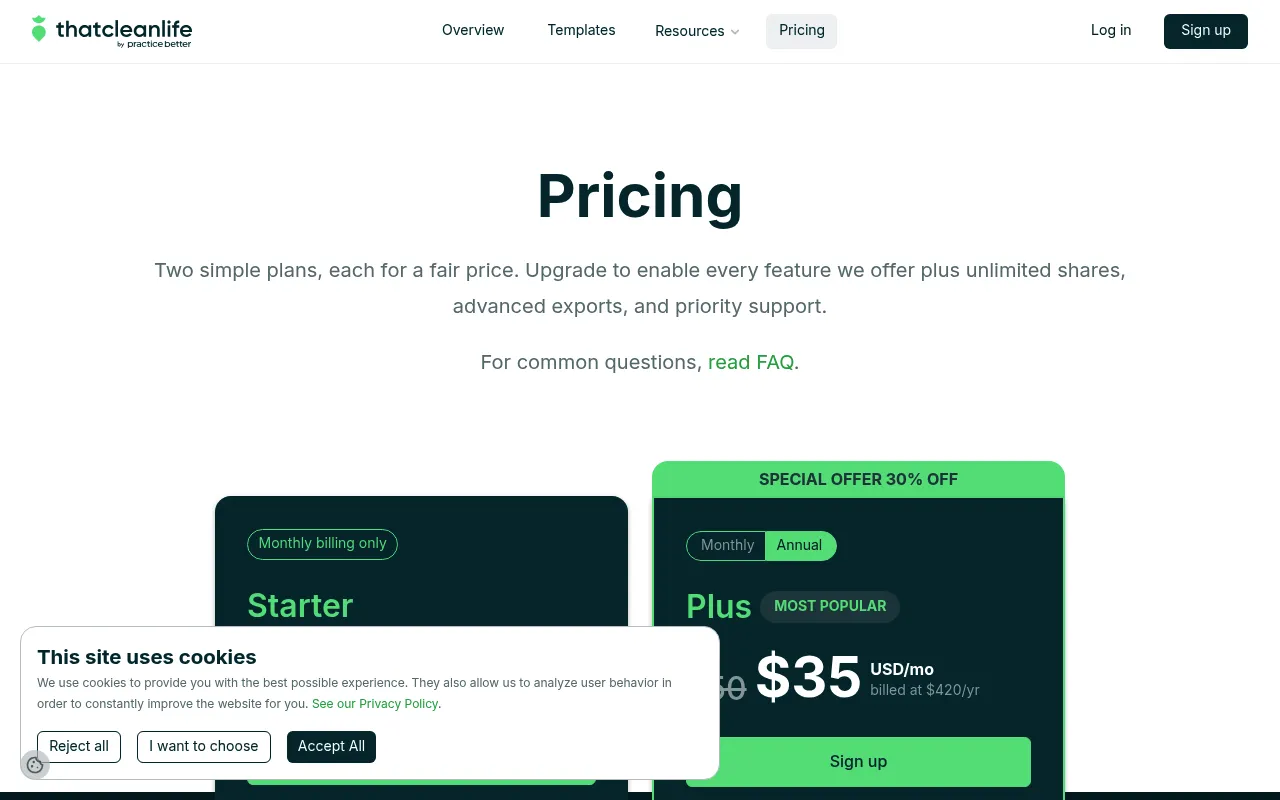
Pricing starts at $30/month for Starter (monthly only, no annual), which caps you at 10 client shares and strips out automation and branded exports. Plus sits at $60/month monthly or $35/month billed annually, which is where most working dietitians actually land. There's no free tier and no free trial. You subscribe to test.
What TCL does not do: telehealth, SOAP notes, anthropometry, appointment scheduling, clinical assessments, or multilingual support. The interface is English-only, full stop. For a dietitian in Quebec, Madrid, or Mexico City, that's a hard limit. White-label shows up on the Plus tier as custom PDF branding and client link styling, but it's not a full custom-app experience.
That Clean Life homepage
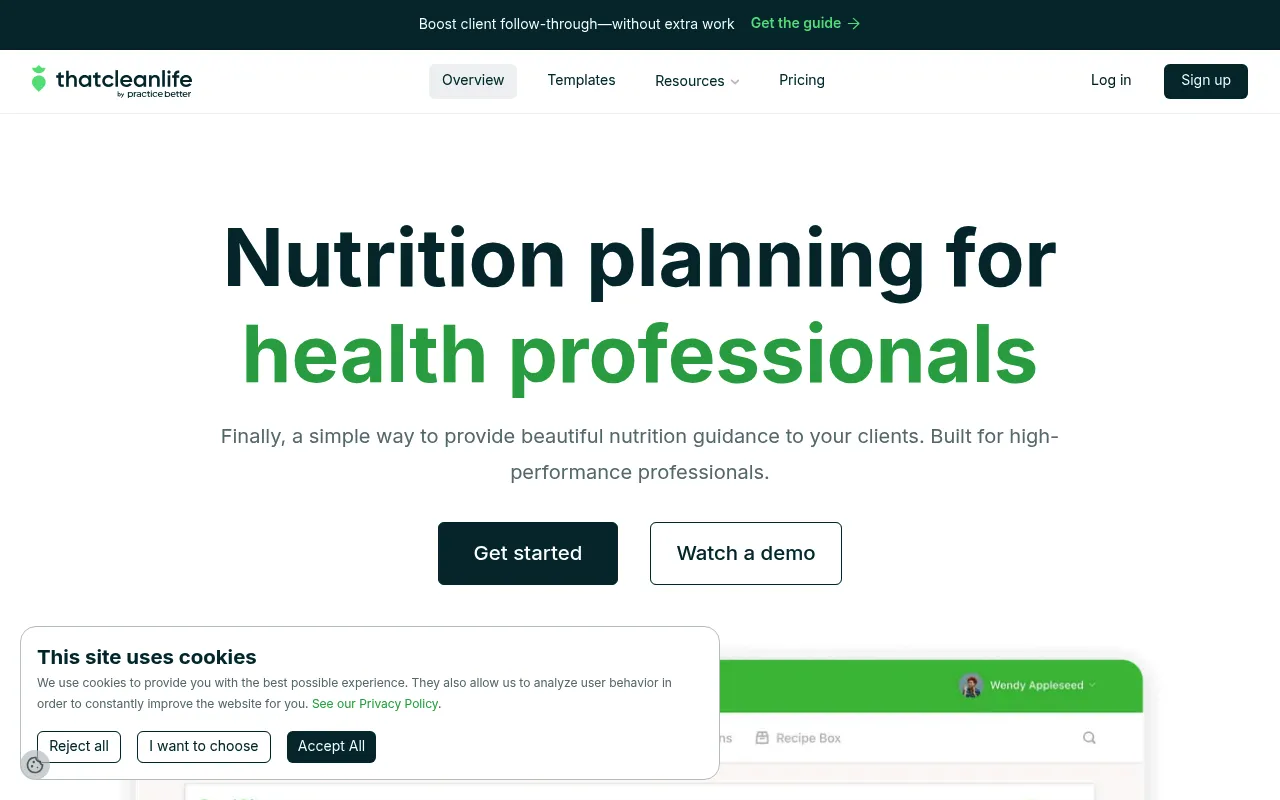
Screenshot captured April 2026.
Nutrium at a glance
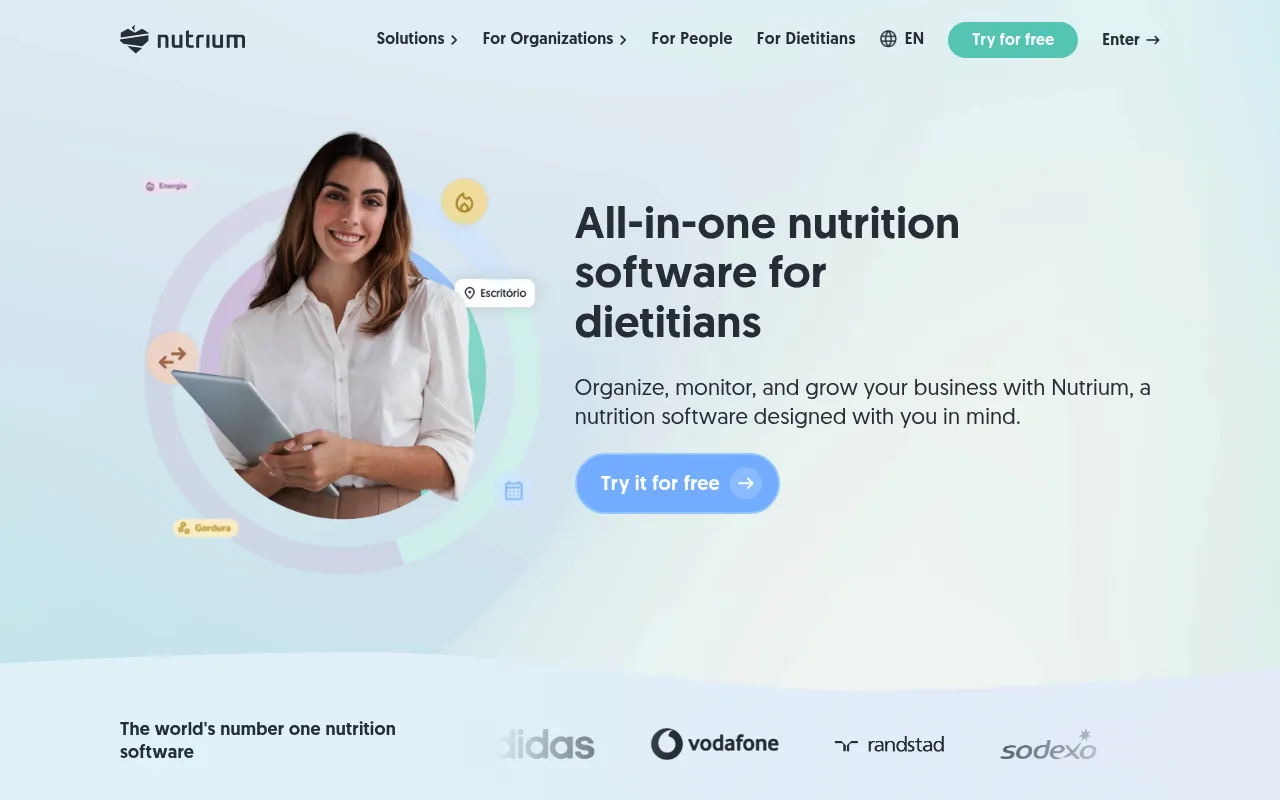
Nutrium launched in Porto, Portugal, around 2013. The origin matters: the Portuguese and Spanish dietetics markets demand heavier clinical documentation than most North American practices, and the platform reflects that reality. Today Nutrium claims 350,000+ registered dietitians across 90+ countries, with the strongest concentrations in Europe, Latin America, and parts of the Middle East.
The positioning is clear: a full practice in one tool. You get meal plans, yes, but also dietary assessments with micronutrient tracking (25+ nutrients, vitamins and minerals), anthropometry with body composition tracking, appointment scheduling with email reminders, built-in telehealth video consultations, SOAP-style consultation notes, client messaging, and payments with invoicing. For a solo clinical dietitian, that covers roughly 90% of what you do in a week.
Pricing is refreshingly simple. The 10-client plan runs $15/month on annual billing ($179/year) or $49/month monthly. The Unlimited plan costs $25/month annually ($299/year) or $39/month monthly. Feature parity across both tiers. You only pay more for client capacity. A 14-day free trial is included, no credit card required upfront.
The clear weaknesses: the recipe library is smaller than TCL's (closer to 100+ templates rather than 8,000+ recipes), the interface is denser and more clinical-feeling than TCL's polished UI, and white-label is non-existent. Every client sees "Nutrium" in their mobile app, on their web portal, and in email templates. That's not a missing feature. That's an architectural choice. The platform is multilingual though: English, Portuguese, Spanish, French, Italian, and more, so a dietitian in Lyon or Barcelona can work in their native language and deliver plans to clients in theirs.
Nutrium homepage
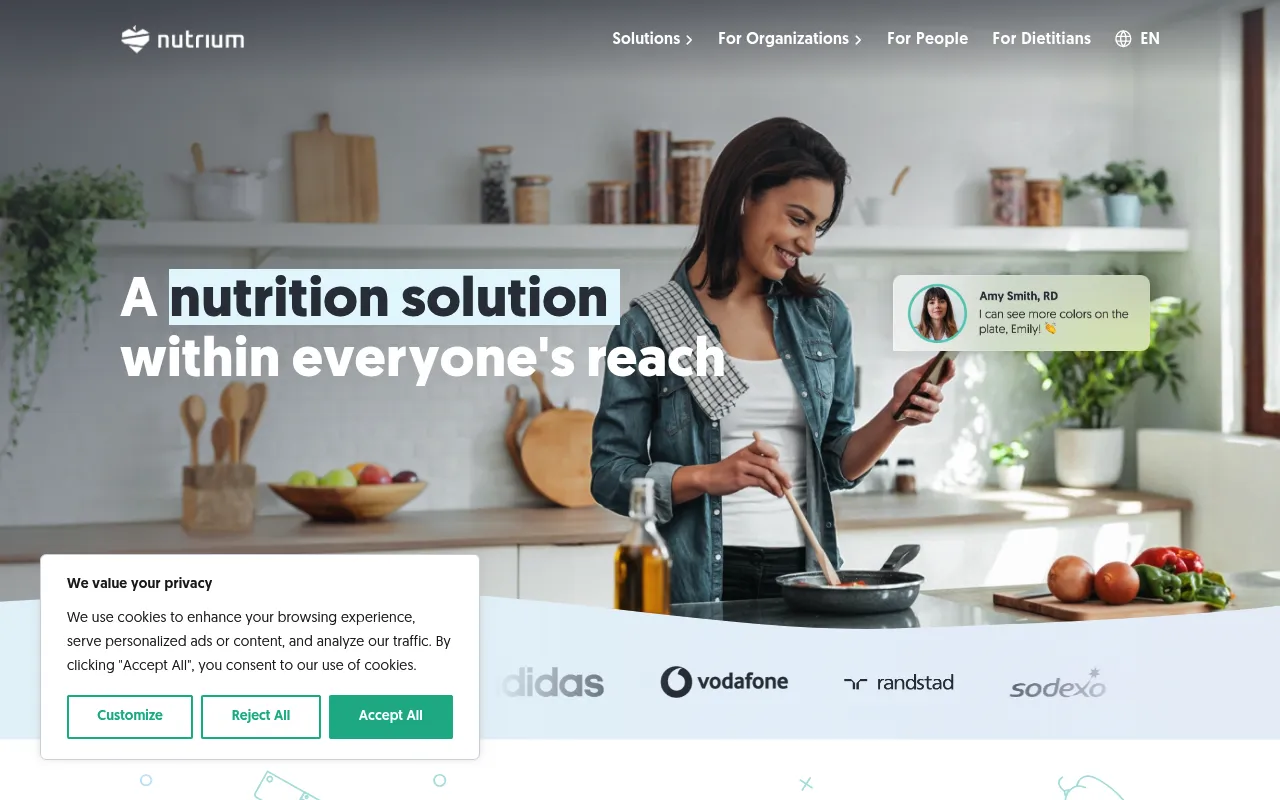
Screenshot captured April 2026.
Feature comparison
Both platforms help dietitians manage clients and build meal plans, but they solve very different problems. One leans hard into recipes and handouts. The other leans hard into telehealth and clinical documentation. Here's where each actually wins.
| Feature | That Clean Life | Nutrium | Winner |
|---|---|---|---|
| Origin | Toronto, ~2015 | Porto, ~2013 | - |
| Positioning | Recipe + handout platform | Clinical practice suite | - |
| Recipe library | 8,000+ professionally developed | ~100+ templates plus custom recipes | That Clean Life |
| Meal plan builder | Auto-generate (Plus) + manual | Manual + clinical assessment flow | That Clean Life (speed) |
| White-label branding | Plus tier only | None (Nutrium-branded throughout) | That Clean Life (partial) |
| Telehealth video calls | Not available | Built-in | Nutrium |
| SOAP-style notes | Not available | Built-in consultation notes | Nutrium |
| Anthropometry & body comp | Basic tracking | Full clinical assessment | Nutrium |
| Multilingual interface | English only | EN, PT, ES, FR, IT, and more | Nutrium |
| Client mobile app | Interactive web link | Nutrium-branded iOS/Android app | Nutrium (app), TCL (branding) |
| Appointment scheduling | Not included | Built-in with reminders | Nutrium |
| Payments & invoicing | Not included | Built-in | Nutrium |
| Condition templates | 150+ (PCOS, FODMAP, gout, more) | Clinical assessment flows | That Clean Life (volume) |
| Practice Better integration | Direct sync | Not available | That Clean Life |
| Client PDF exports | Branded PDFs (Plus) | Nutrium-branded PDFs | That Clean Life |
| Free option | No free tier or trial | 14-day free trial | Nutrium |
| Starting paid price | $30/month (Starter, limited) | $15/month (annual, 10 clients) | Nutrium |
Pricing comparison
Both platforms use two-tier pricing, but the philosophies diverge. TCL gates features behind the higher tier. Nutrium gates only client capacity. That difference changes how each plan scales with your practice.
That Clean Life plans
| Plan | Price | Clients | Included |
|---|---|---|---|
| Starter | $30/month (monthly only) | 10 shares | Recipe library, basic filters, macros only, 65+ templates |
| Plus (monthly) | $60/month | Unlimited | Automation, branded PDFs, 150+ templates, 25+ nutrients |
| Plus (annual) | $35/month ($420/year) | Unlimited | Same as Plus monthly, 42% savings on annual |
See That Clean Life's full pricing page. Pricing shown as of April 2026.
Nutrium plans
| Plan | Price | Clients | Included |
|---|---|---|---|
| 10 Clients (annual) | $15/month ($179/year) | 10/month | All features (meal plans, telehealth, scheduling, SOAP, invoicing) |
| 10 Clients (monthly) | $49/month | 10/month | All features |
| Unlimited (annual) | $25/month ($299/year) | Unlimited | All features + unlimited client cap |
| Unlimited (monthly) | $39/month | Unlimited | All features |
Nutrium includes a 14-day free trial with full access, no credit card required. Quirk: the monthly 10-client plan ($49/mo) is actually more expensive than the monthly Unlimited plan ($39/mo). If you're paying monthly, Unlimited is the obvious pick.
Real-world cost: dietitian with 30 clients
Run the numbers for a working dietitian managing 30 active clients per month. On That Clean Life, you're past the Starter cap (10 shares) so you need Plus. That's $60/month monthly or $35/month on annual ($420/year). On Nutrium, you're also past the 10-client plan, so you need Unlimited. That's $39/month monthly or $25/month annually ($299/year). On annual billing, Nutrium costs $121 less per year and gives you telehealth, SOAP notes, scheduling, and invoicing on top of meal planning. If you only need recipes and handouts, TCL's premium pricing buys you a bigger library. If you need any clinical workflow, Nutrium pays for itself inside three months.
Where That Clean Life wins
The 8,000+ recipe library
This is TCL's clearest edge. Every recipe is developed in-house, tested, photographed, and tagged by dietary filter. If a client has a specific preference (Mediterranean, plant-based, gluten-free, low-FODMAP), you have real depth to pull from rather than repeating the same 20 dishes. Nutrium's recipe side is closer to a curated starter set plus whatever you build yourself. For practices where recipes are the product, TCL wins outright.
Client handouts and educational resources
The handouts library is underrated. Printable PDFs on portion control, grocery shopping, eating out, and specific conditions (gout triggers, PCOS-friendly swaps, low-FODMAP phase 1 reintroduction). Designed, not templated. For a dietitian who spends consultations educating clients, these materials save real hours of prep work each week.
Plus-tier white-label on PDFs and client links
Plus-tier TCL lets you export branded PDFs with your logo and colors. Client sharing links can carry your branding too. It's not a fully custom client app, but it's more brand presence than Nutrium allows anywhere. If you pay the Plus price, the output actually looks like yours.
Clean, modern UI
TCL's interface feels closer to a consumer recipe app than a clinical tool. Less nesting, faster navigation, better recipe photography throughout. A new hire on your team can pick it up in under an hour. Nutrium's clinical density takes longer to learn.
Community and seasonal updates
TCL pushes fresh recipes and seasonal collections regularly (holiday plans, summer produce, quick weeknight dinners). There's an active community of RDs trading template ideas. It feels alive in a way clinical-software products rarely do.
Where Nutrium wins
Multilingual interface out of the box
English, Portuguese, Spanish, French, Italian, and more. Both the dietitian dashboard and the client-facing experience translate. For a RD in Lyon, Barcelona, Lisbon, or Mexico City, this isn't a nice-to-have. It's the difference between a tool you can use professionally and one you can't. TCL's English-only stance simply doesn't work outside North America and the UK.
Clinical assessment tools
SOAP-style consultation notes, structured dietary assessments with micronutrient breakdowns (25+ vitamins and minerals), anthropometry, body composition tracking, and client history documentation. These are the tools a clinical dietitian actually uses during a consult. TCL treats consultation as an export-a-plan moment. Nutrium treats it as the core workflow.
Integrated telehealth
Video calls happen inside the platform, with session notes, meal plan adjustments, and follow-up scheduling all in one place. No separate Zoom account, no copy-paste between tools. For remote practices or hybrid clinics, this single integration alone can justify the $25/month annual price.
International reach and strict-market credibility
Nutrium's 350K+ dietitian base and 90-country footprint aren't marketing decoration. In strict European and Latin American markets where clinical documentation is heavily regulated, Nutrium has earned credibility because its documentation model fits those regulations. TCL has minimal presence outside English-speaking Anglo markets.
Lower entry price on annual billing
$15/month (10-client annual) or $25/month (Unlimited annual) beats TCL's $30/month Starter and $35/month Plus annual on pure price. And Nutrium includes the full feature set on both tiers: telehealth, SOAP, scheduling, invoicing. You're not paying more for the good stuff. Plus the 14-day free trial lets you test every feature before subscribing.
Need white-label on every plan plus macro-first meal plans? Promealplan ships with full custom branding on every tier, 1,000+ dietitian-validated recipes, 200+ allergy filters, and three locales (EN, FR, ES). Start free with 3 meal plans, no credit card.
Create 3 free meal plans →The white-label gap both platforms share
Here's the part every comparison article seems to skip. Both TCL and Nutrium have structural limits on white-label, and for any dietitian building a personal brand, this matters more than recipe count or feature depth.
Nutrium is the clearer limit. There is no white-label, at any tier, on any feature. The client mobile app shows "Nutrium" when your client opens it. The web portal shows Nutrium branding. Email reminders reference Nutrium. PDF exports carry Nutrium's identity. You cannot remove this. It's baked into the architecture. For a dietitian whose clients pay a premium for a personalized, branded experience, this is a real trade-off against all the clinical strength the platform offers.
That Clean Life is more nuanced, but still limited. The Starter plan at $30/month gives you zero custom branding. Your clients see TCL branding on shared links and exports. Branded PDFs and branded client sharing only appear on the Plus tier ($35-60/month). Even on Plus, you're not getting a fully custom client app. You're getting TCL's platform wearing your logo on specific deliverables. For the starter-tier dietitian who wants their brand visible from day one, TCL's gating feels punitive.
For many dietitians, the workaround is to pair one of these platforms with a dedicated meal planning tool that includes white-label on every plan. Dietitians who've explored the That Clean Life alternatives for coaches or the Nutrium alternatives for coaches tend to land on a similar setup: keep the clinical or recipe platform for what it does best, add a branded meal planning layer on top.
Promealplan is built around this gap. Full white-label on every plan (your logo, your colors, your business name across PDFs and the client portal). 1,000+ dietitian-validated recipes. 200+ allergy and intolerance filters. Three locales out of the box. A deterministic macro-targeted engine rather than AI-generated recipes. Every plan respects exact calorie and macro targets, and every recipe is human-validated. Trustpilot rating: 4.5 stars. Free to start with 3 meal plans, no credit card.
The pairing is practical, not theoretical. Nutrium runs your telehealth visits and clinical documentation. Promealplan ships the meal plans your clients actually follow, under your brand. Two tools, no workflow overlap, total cost lower than most all-in-one premium tiers.
How to decide in under 15 minutes
Most comparison articles bury the decision under feature matrices. The honest answer is simpler: three questions tell you which platform fits.
Question one: do you run telehealth consultations, or do you mostly deliver recipes and handouts? Telehealth-heavy means Nutrium, full stop. Video visits inside the platform with SOAP notes attached to the client record is a workflow TCL simply doesn't offer. Recipe-heavy means TCL wins on library depth and handout polish. If you're split roughly 50/50, lean Nutrium and add TCL's free public blog as a reference while you build your own recipe set inside Nutrium.
Question two: what language do your clients read? All English? Either platform works. Any French, Spanish, Portuguese, or Italian in the client base? Nutrium is the only viable choice. Browser-translating a dietitian tool into your client's language is not a professional solution, and TCL's English-only recipes won't translate to Mexican or European dietary norms anyway.
Question three: how important is your brand in the client experience? If your clients pay premium fees and expect your logo on every deliverable, neither platform fully delivers. TCL gets you branded PDFs on Plus but not a custom client app. Nutrium shows its own brand everywhere. In both cases, pairing with a dedicated white-label meal planning tool (Promealplan on every tier) is the realistic path to a fully branded experience.
Who should pick which
Clinical dietitian in private practice with telehealth visits
Pick Nutrium. The telehealth integration, SOAP notes, anthropometry, and appointment scheduling cover the full consultation workflow in one platform. At $25/month annual for Unlimited, the economics beat stitching together Zoom, Calendly, a SOAP tool, and a meal planner. If your clients expect consistent branded materials, pair Nutrium with Promealplan for the meal plan layer.
Content-heavy dietitian with a handouts focus
Pick That Clean Life Plus. The 8,000+ recipe library, 150+ condition templates, and handouts library give you material for weeks. If you educate through printed and shared resources more than telehealth consultations, TCL's depth outperforms Nutrium's clinical tooling for your use case. Budget $35/month on annual billing.
Multilingual dietitian in Europe or Latin America
Pick Nutrium. It's not a close call. TCL's English-only interface is a blocker if you practice in Spanish, French, Portuguese, or Italian. Nutrium covers all of those natively, both for you and for your clients. If you also need white-label macro plans, pair Nutrium with Promealplan (which ships in EN, FR, and ES).
Dietitian launching their own brand
Neither platform alone gives you the full branded experience clients expect from a premium service. Nutrium shows Nutrium branding throughout. TCL shows TCL branding unless you pay for Plus, and even then you're getting branded PDFs, not a branded app. Pair your chosen practice platform with Promealplan for white-label meal plans and a branded client portal. Your brand ends up where it matters: in the client's hands.
Can you switch later?
Yes, and easily. Meal planning tools generate plans from their own recipe databases, so there's no data migration involved when you move. You recreate the client profiles in your new tool, plug in their dietary targets and allergy filters, and generate fresh plans. Most dietitians complete a switch in a single afternoon.
The rarer question is whether you'd switch at all. In practice, most dietitians who start on TCL or Nutrium don't leave the platform. They add a second tool. A TCL Plus user who finds clients asking for telehealth visits adds Nutrium. A Nutrium user whose marketing shifts toward branded client experience adds Promealplan for the white-label meal plan layer. Tools coexist rather than replace each other, because each one covers a workflow the other doesn't.
The practical advice: don't over-optimize the initial pick. Start with whichever fits your primary workflow today, and add specialized tools as new needs appear. The annual cost of running two focused platforms is almost always lower than paying for a premium tier you partially use.
Verdict
This isn't a winner-takes-all comparison. That Clean Life and Nutrium solve different problems, and the right pick depends on how your practice runs. TCL is the recipe and handouts platform: deep library, clean UI, strong Practice Better integration, but English-only and no clinical workflow. Nutrium is the clinical practice suite: telehealth, SOAP, scheduling, invoicing, and seven languages, but a smaller recipe library and zero white-label.
Both share the same structural limit: white-label isn't available across the full client experience on either platform. Nutrium has none at all. TCL gates it behind Plus and still doesn't offer a fully custom client app. For any dietitian whose brand is part of the product, this is the constraint worth solving before you optimize recipe count or telehealth polish.
Promealplan pairs naturally with either platform: macro-first meal plans, 1,000+ dietitian-validated recipes, 200+ allergy filters, white-label on every tier, and three locales (EN, FR, ES). Free to try, no credit card. Run a Nutrium trial, a TCL subscription, or both. Pair whichever fits your workflow with a branded meal plan layer on top.
Frequently asked questions
How much do That Clean Life and Nutrium cost in 2026?
That Clean Life runs two paid tiers with no free plan: Starter at $30/month (monthly only, 10 client shares) and Plus at $60/month or $35/month billed annually ($420/year). Nutrium also runs two tiers but keeps the feature set identical across both. The 10-client plan costs $15/month billed annually ($179/year) or $49/month monthly. The Unlimited plan costs $25/month annually ($299/year) or $39/month monthly. Nutrium includes a 14-day free trial. Both climb past $30/month for most working dietitians, and Plus-tier TCL costs more than Nutrium Unlimited on annual billing.
Which is better for a clinical dietitian in private practice?
Nutrium, by a clear margin. It was built for clinical nutrition from day one. You get telehealth video calls, SOAP-style consultation notes, anthropometry, body composition tracking, appointment scheduling, and invoicing inside the platform. That Clean Life is strong on recipes and handouts, but it has no telehealth, no clinical assessment tools, and no integrated booking. If your practice runs on consultations, follow-ups, and documented clinical records, Nutrium covers the workflow. TCL does not.
Can I brand either platform as my own (white-label)?
Not fully on either one. Nutrium has zero white-label. The client app, web portal, and communication templates all carry Nutrium branding. No setting, no tier, no workaround changes this. That Clean Life offers branded PDF exports and branded client sharing, but only on the Plus plan ($35-60/month). The Starter plan gives you no custom branding at all. For a dietitian building a personal brand that clients see at every step, this is a real limit on both platforms. Promealplan includes full white-label on every plan.
Can I use Promealplan alongside That Clean Life or Nutrium?
Yes, and plenty of dietitians do. The tools don't overlap. Keep Nutrium for telehealth, clinical documentation, and scheduling, or TCL for its 8,000+ recipe library and condition-specific handouts. Then use Promealplan for macro-targeted meal plans with 200+ allergy filters, 1,000+ dietitian-validated recipes, and white-label PDFs and client portal under your own brand. Most dietitians spin up Promealplan alongside one of the other two to fill the branding and macro-precision gap, not to replace their existing platform.
Which should I pick if I'm new to meal planning software?
It depends on what you do. Clinical dietitian running telehealth consults? Start with Nutrium's 14-day trial. Recipe-heavy practice serving English-speaking clients with handouts and printed plans? Start with That Clean Life. Coach or dietitian who needs white-label on every deliverable, macro-focused output, and a tool that works in English, French, or Spanish? Promealplan has a free plan (3 meal plans, no credit card) so you can test it before touching a paid subscription. Nothing wrong with trialing two tools in the same week. You'll know within an hour which one fits your workflow.
Pair your practice platform with a real branded meal plan layer
Promealplan delivers white-label meal plans on every tier, 1,000+ dietitian-validated recipes, 200+ allergy filters, and three locales. Start free with 3 meal plans, no credit card required.
Create 3 free meal plansRelated articles
That Clean Life Review 2026: honest take for dietitians
8,000+ recipes, Practice Better integration, and what the Starter plan doesn't include.
Nutrium Review 2026: clinical nutrition software for dietitians
Features, telehealth, pricing, and who it actually fits.
Best That Clean Life alternative for coaches
Why coaches pair TCL with a dedicated macro-first meal planning tool.
Best Nutrium alternative for coaches
When Nutrium's clinical focus doesn't fit a macro-based coaching workflow.
Dietitian meal planning software: tools for a smoother practice
Top tools for nutritionists covering features, pricing, and white-label options.